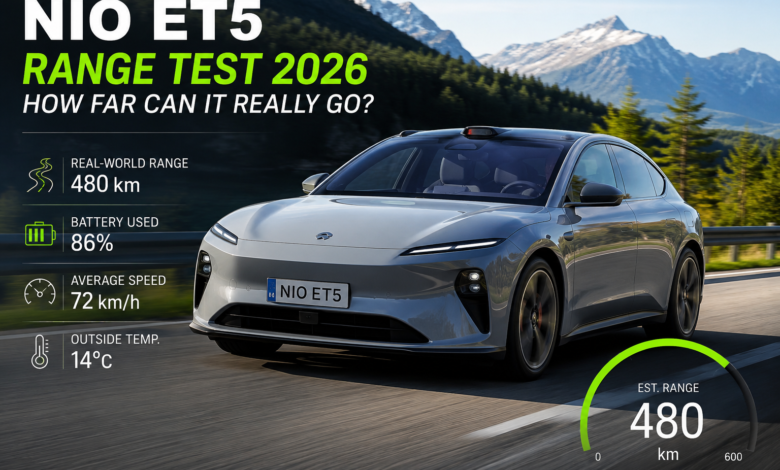
NIO ET5 range is one of the biggest deciding factors for buyers considering this premium electric saloon. While the official WLTP figure paints an optimistic picture, everyday driving tells a more nuanced story. Factors such as motorway speeds, outside temperature, terrain and driving style all influence how far the ET5 can realistically travel on a charge.
For UK and European buyers, understanding real-world performance matters far more than laboratory testing. Whether you’re commuting, travelling across the motorway network or managing a company fleet, this guide explains what you can genuinely expect from the NIO ET5 in everyday use.
Quick Answer
The NIO ET5 offers an impressive official WLTP range depending on battery version, but real-world driving typically delivers around 70–90% of the official figure depending on weather, speed, terrain and traffic. Urban driving generally produces the best efficiency, while sustained motorway speeds and cold winter temperatures reduce overall range.
At-a-Glance Summary
| Category | Summary |
|---|---|
| Vehicle Type | Premium Electric Saloon |
| Drive Layout | Dual-Motor All-Wheel Drive (variant dependent) |
| Official Range | Varies by battery option (WLTP) |
| Real-World Expectation | Typically 70–90% of WLTP |
| Best Driving Environment | Urban and mixed roads |
| Biggest Range Reduction | High-speed motorway driving and winter conditions |
| Fast Charging | DC rapid charging supported (speed depends on battery and charger) |
| Battery Swap | Available in selected NIO markets |
Understanding NIO ET5 Range
Official WLTP figures provide a useful comparison between electric vehicles, but they should not be treated as guaranteed real-world results.
Laboratory testing follows controlled procedures with moderate temperatures, limited use of climate control and predictable driving cycles. Everyday journeys are rarely that consistent.
In practical ownership, your range depends on:
- Average speed
- Outside temperature
- Elevation changes
- Passenger and luggage weight
- Wheel size
- Climate control usage
- Driving style
- Traffic conditions
Understanding these variables helps owners plan journeys more accurately.
Real-World NIO ET5 Range Expectations
Most EV owners experience different results depending on where and how they drive.
Urban Driving
City driving generally allows regenerative braking to recover energy during frequent slowing and stopping. Lower speeds also reduce aerodynamic drag, making urban conditions the most efficient environment for the ET5.
Drivers who mainly commute through towns or cities may come closest to the official WLTP figure.
Mixed Driving
A combination of urban roads, rural routes and occasional motorway travel typically provides the most representative everyday experience for UK motorists.
Most owners can expect comfortably usable daily driving without frequent charging stops.
Motorway Driving
At motorway speeds, aerodynamic resistance increases significantly.
Travelling consistently at around 70 mph requires much more energy than urban driving, meaning range decreases noticeably compared with WLTP testing.
This is normal across virtually every modern electric vehicle, not just the ET5.
Winter Driving
Cold weather affects both battery chemistry and cabin heating demands.
Lower temperatures can temporarily reduce available battery performance until the battery reaches its optimal operating temperature.
Vehicles equipped with an efficient heat pump generally perform better in winter than those relying solely on resistive heating, although actual equipment varies by market and specification.
Battery Technology and Efficiency
The NIO ET5 is built around modern lithium-ion battery technology and is offered with multiple battery capacity options depending on market availability.
Rather than focusing solely on battery size, buyers should also consider overall efficiency.
Efficiency reflects how effectively the vehicle converts stored electricity into usable driving distance.
Factors contributing to efficiency include:
- Aerodynamic body design
- Low rolling resistance tyres
- Intelligent thermal management
- Regenerative braking
- Advanced battery management software
- Regular over-the-air software improvements
Battery capacity alone does not determine range—vehicle efficiency plays an equally important role.
Charging Performance and Long-Distance Travel
Long-distance usability depends on more than maximum range.
Charging performance is equally important.
Although peak DC charging figures attract attention, charging curves provide a better indication of real-world convenience. Many EVs only achieve peak charging speeds briefly before gradually reducing power to protect battery health.
Charging time is influenced by:
- Battery state of charge
- Charger power
- Battery temperature
- Battery version
- Charging conditions
For motorway journeys, shorter charging stops between roughly 10% and 80% battery are often more time-efficient than charging to 100% every time.
One unique feature associated with NIO is its battery swap ecosystem, available in selected European markets. Where infrastructure exists, battery swapping can reduce waiting times compared with conventional charging. Availability, however, varies considerably by country.
What Affects the NIO ET5 Range Most?
Several everyday habits have a noticeable impact on driving distance.
Speed
Higher speeds dramatically increase energy consumption due to aerodynamic drag.
Temperature
Cold weather reduces battery efficiency and increases cabin heating demand.
Wheel Size
Larger alloy wheels typically reduce efficiency compared with smaller wheel options.
Tyre Pressure
Correct tyre pressures reduce rolling resistance and improve energy efficiency.
Driving Style
Smooth acceleration and anticipation maximise regenerative braking.
Climate Control
Heating consumes considerably more energy than ventilation, especially during winter.
Practical Ownership in the UK and Europe
For most UK drivers, daily mileage is well within the capability of modern premium EVs.
Owners with home charging benefit from waking each morning with a full battery, reducing reliance on public charging.
Fleet operators may appreciate:
- Lower maintenance requirements
- Predictable energy costs
- Zero tailpipe emissions
- Quiet motorway refinement
- Potential tax advantages (subject to local regulations)
Drivers without access to home charging should evaluate local public charging availability before purchasing any EV.
Driver Assistance and Technology
While range remains the headline figure, the overall ownership experience also depends on technology.
Depending on specification and market, buyers may find features such as:
- Advanced driver assistance systems (ADAS)
- Adaptive cruise control
- Lane-centering assistance
- Regenerative braking adjustment
- One-pedal driving modes
- Over-the-air software updates
- Large infotainment display
- Intelligent route planning
Route planning systems that automatically include charging stops can reduce range anxiety during longer journeys.
NIO ET5 Range Compared with Key Rivals
| Model | Strengths |
|---|---|
| Tesla Model 3 Long Range | Excellent efficiency and extensive charging ecosystem |
| BMW i4 | Premium interior and refined motorway comfort |
| Hyundai Ioniq 6 | Outstanding aerodynamic efficiency |
| Polestar 2 | Strong build quality and intuitive software |
| BYD Seal | Competitive value with modern battery technology |
Rather than focusing solely on the highest WLTP number, buyers should compare charging infrastructure, software support, ownership costs and everyday efficiency.
Should Range Be Your Main Buying Factor?
Range is important, but it shouldn’t be the only consideration.
Charging convenience, battery efficiency, ride comfort, reliability, technology and aftersales support all contribute to long-term satisfaction.
For drivers covering moderate daily distances, an EV with slightly lower range but better charging availability may prove the more practical choice.
Expert Verdict
The NIO ET5 range is competitive within the premium electric saloon segment, particularly when viewed alongside its modern battery technology and advanced software features.
Realistically, buyers should expect lower figures than the official WLTP rating during motorway journeys and winter driving, but this is consistent with virtually every current-generation electric vehicle.
Who Should Buy It?
- Premium EV buyers
- Company car drivers
- Fleet operators
- Drivers with home charging
- Regular urban and mixed-route commuters
Who Should Look Elsewhere?
- Drivers without reliable charging access
- Buyers prioritising the widest public charging ecosystem
- Those regularly undertaking very long motorway journeys where charging infrastructure is limited
If your priorities include refinement, modern technology and competitive real-world efficiency, the NIO ET5 range should comfortably meet the needs of many UK and European drivers.
More EV Car Guides: Read more electric vehicle news, buying guides, reviews, and ownership tips on magazinerock.co.uk.
(FAQs)
What is the real-world NIO ET5 range?
The real-world NIO ET5 range typically reaches around 70–90% of the official WLTP figure, depending on weather, driving style, terrain and average speed.
Does motorway driving reduce the NIO ET5 range?
Yes. Sustained motorway speeds increase aerodynamic drag, meaning energy consumption rises and driving range falls compared with urban or mixed driving.
How much does winter affect EV range?
Cold temperatures reduce battery efficiency and increase energy used for cabin heating, so most electric vehicles experience shorter driving range during winter.
Is the NIO ET5 suitable for long-distance travel?
Yes, provided charging stops are planned appropriately. Fast DC charging and, in selected markets, NIO’s battery swap network help make longer journeys more practical.
Is the NIO ET5 a good fleet vehicle?
For many fleet operators, the ET5 offers attractive efficiency, lower maintenance requirements, advanced driver assistance technologies and competitive operating costs, although local charging infrastructure should be assessed before adoption.