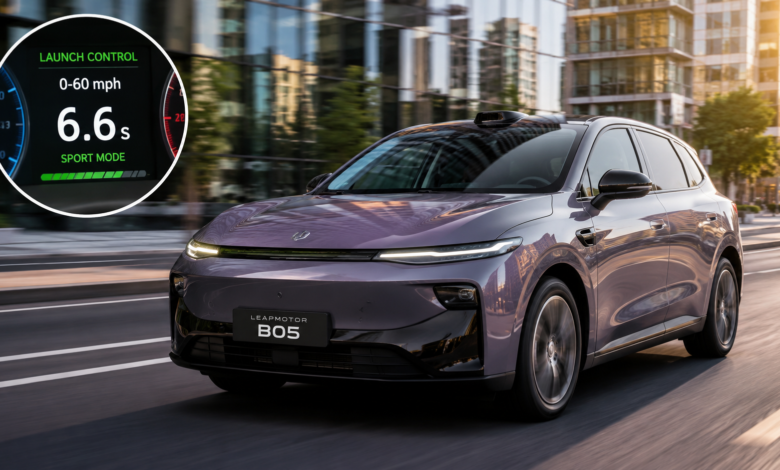
The leapmotor b05 0-60 figure has attracted attention because this compact electric hatchback combines rear-wheel drive, more than 200 horsepower, and a dedicated Launch Control function. Leapmotor officially quotes a 0–62 mph time of 6.7 seconds for the European B05, making it a genuinely brisk everyday EV rather than an outright hot hatch. The car produces 160 kW, equivalent to around 215–218 hp depending on the market’s stated specification, and sends 240 Nm of torque to the rear wheels. That combination gives the B05 a useful balance between efficiency, comfort, and straight-line performance.
However, acceleration numbers do not tell the whole story. The way the B05 delivers its power, how Sport mode changes the response, how traction is managed, and what Launch Control actually does are equally important. Here is a detailed look at the B05’s acceleration performance and what drivers can realistically expect.
What Is the Leapmotor B05 0-60 Performance?
The leapmotor b05 0-60 discussion needs one important clarification: Leapmotor’s published European performance figure is officially measured from 0 to 62 mph, rather than exactly 0 to 60 mph. The quoted 0–62 mph time is 6.7 seconds. Because 60 mph is slightly below 62 mph, an exact 0–60 mph result would normally be marginally quicker, but it should not be presented as an official factory figure unless Leapmotor publishes one for a particular market.
That 6.7-second 0–62 mph time places the B05 in an interesting performance category. It is quick enough to make merging onto highways effortless and to provide convincing acceleration from traffic lights, but it is not engineered primarily as a high-performance sports car.
This distinction matters. Electric vehicles can feel extremely fast because maximum torque is available almost immediately, yet the B05 has been calibrated to deliver its performance in a relatively controlled manner. Independent road tests have described the acceleration as brisk and smooth rather than dramatic, particularly when compared with more powerful performance-oriented EVs.
For normal driving, that is arguably an advantage. The B05 does not need aggressive throttle calibration to feel responsive, and its power is accessible without making everyday driving tiring.
Powertrain and Electric Motor Explained
At the heart of the B05 is a rear-mounted permanent-magnet electric motor producing approximately 160 kW of maximum power and 240 Nm of torque. Unlike a conventional petrol hatchback that has to build engine speed and shift through gears, the B05’s single-speed electric drivetrain can deliver propulsion directly through the rear wheels.
The leapmotor b05 0-60 performance therefore depends on more than its horsepower figure. Instant electric torque, the traction available from the rear tyres, battery output, vehicle weight, and electronic control systems all influence how quickly the car leaves the line.
The B05 uses a 67.1 kWh battery in the European specification, while its battery-integrated Cell-to-Chassis architecture helps make the battery a structural part of the vehicle. The car weighs roughly 1,837 kg in the specification tested by UK automotive media, so it is not an especially lightweight hatchback. Nevertheless, the electric motor has enough output to produce respectable acceleration.
Its rear-wheel-drive layout also gives the leapmotor b05 0-60 a different character from many front-wheel-drive compact EVs. With power sent to the rear axle, steering duties are separated from propulsion, potentially giving the driver a cleaner feel when accelerating out of corners.
How Launch Control Changes Acceleration
One of the B05’s more unusual features for its price class is Launch Control. This system is designed specifically for hard acceleration from a standstill. Instead of simply pressing the accelerator and allowing the vehicle’s normal driving calibration to determine the launch, the system prepares the powertrain and traction-control systems for maximum controlled acceleration.
The leapmotor b05 0-60 result is most closely associated with Launch Control because the feature is intended to extract the car’s strongest standing-start performance. Leapmotor pairs the function with Sport mode, giving the driver a more aggressive acceleration response than the relaxed Comfort setting.
The basic process is similar to launch systems used in other performance cars. The driver selects the appropriate performance setting, holds the brake while applying accelerator input, and then releases the brake to initiate the launch. The vehicle’s electronic systems manage the available torque and traction as the car moves away.
That does not mean Launch Control magically adds horsepower. Instead, it coordinates the existing motor output, battery power, throttle response, and traction management to make the start as consistent and effective as possible.
For an EV costing considerably less than many dedicated performance models, having this technology is notable. At the same time, drivers should remember that a launch-control system is primarily a performance feature rather than something required for ordinary commuting.
Sport Mode, Comfort Mode and Power Delivery
The B05 offers three main driving modes: Comfort, Standard, and Sport. Each changes the character of the vehicle rather than simply altering a single acceleration setting.
Comfort prioritizes smoother acceleration and a more relaxed driving experience. This is useful in heavy traffic, urban areas, and situations where precise throttle control matters more than outright response.
Standard provides a middle ground and is likely to be the most suitable setting for everyday driving. Acceleration remains responsive without becoming unnecessarily aggressive.
Sport is where the performance character becomes more obvious. Throttle response becomes sharper, regenerative braking is stronger, and steering assistance is adjusted to provide a firmer sensation. Launch Control works alongside this performance-focused setup when the driver wants maximum standing-start acceleration.
This explains why the leapmotor b05 0-60 experience can feel different depending on the selected mode. The motor’s maximum power does not suddenly increase because Sport mode is selected, but the way that power is delivered to the driver changes.
Rear-Wheel Drive and Traction
Rear-wheel drive is one of the most important characteristics influencing the B05’s acceleration. Sending the motor’s output to the rear wheels can provide useful traction during hard acceleration because the vehicle’s weight shifts rearward as it launches.
The B05 also uses an approximately 50:50 weight distribution, which supports balanced handling. Its chassis combines MacPherson struts at the front with an independent multi-link arrangement at the rear. The suspension was developed with European road conditions in mind.
For acceleration, the electronic traction-control system remains crucial. Electric motors can produce torque extremely quickly, so unrestricted power delivery could easily overwhelm the tyres. Instead, the B05 continuously manages the available grip.
In real-world conditions, road temperature, tyre condition, surface quality, battery charge, and weather can all influence acceleration. A quoted factory time should therefore be regarded as a controlled benchmark rather than a guarantee that every driver will reproduce the same result.
Is the B05 Actually a Performance Car?
The leapmotor b05 0-60 figure looks sporty on paper, but the B05 should not be confused with a dedicated performance hatchback. Its 6.7-second 0–62 mph time is respectable, but the vehicle is designed to combine performance with comfort, efficiency, practicality, and affordability.
That balance becomes clearer once the car is driven beyond a straight-line acceleration test. Reviews of the B05 generally highlight its comfortable ride and refined cabin, while some testers have noted that the steering lacks the sharpness and feedback associated with more enthusiast-focused hatchbacks.
This is not necessarily a weakness. Most buyers of a compact EV want easy acceleration, quiet cruising, comfortable suspension, and predictable handling. The B05’s approach makes sense for that audience.
The available performance is also useful in practical situations. Quick acceleration can make joining a motorway easier, provide additional confidence during overtaking, and reduce the hesitation that some drivers associate with slower entry-level EVs.
Battery, Weight and Real-World Performance
Battery technology has a direct relationship with acceleration. The B05’s 67.1 kWh battery provides a substantial energy reserve, but performance depends on how much power the battery-management system can provide at a given moment.
Battery state of charge can influence performance in some electric vehicles, particularly when the battery becomes very low or extremely cold. Temperature management is therefore an important part of maintaining consistent EV performance.
The B05 also uses an oil-cooled electric drive system designed to improve efficiency and thermal management. This is particularly relevant when considering repeated hard acceleration. A single launch is one thing; repeated high-power runs generate considerably more heat.
For everyday owners, however, there is little reason to repeatedly use Launch Control. The B05’s normal acceleration is already sufficient for urban and highway driving, while gentler throttle use will generally be more appropriate for efficiency and comfort.
What Makes the B05’s Performance Competitive?
The strongest argument for the B05 is not simply its acceleration number. It is the combination of 215-hp-class power, rear-wheel drive, a 67.1 kWh battery, balanced chassis engineering, and standard Launch Control in a relatively affordable compact EV.
Its aerodynamic design also contributes to efficiency, with a claimed drag coefficient of 0.26. The European specification offers a stated WLTP range of up to 300 miles, showing that Leapmotor has not focused exclusively on acceleration.
That combination makes the B05 different from an EV designed solely to win acceleration comparisons. It attempts to offer a more rounded package where performance is available when requested but does not dominate the vehicle’s entire character.
The result is an EV that can be comfortable during a long commute, efficient during everyday use, and entertaining when the driver selects Sport mode.
How the B05 Compares With Expectations
When people search for the leapmotor b05 0-60, they may expect the car to deliver the dramatic launch associated with some high-performance electric vehicles. That expectation needs to be moderated.
The B05’s official 0–62 mph time of 6.7 seconds is quick, but road testers have generally found its acceleration more controlled than explosive. Some competing EVs with stronger power outputs can provide a more forceful initial hit.
That does not make the B05 slow. Instead, it shows why performance figures need context. A car can have a respectable acceleration time without feeling violently quick from behind the wheel.
The B05’s approach is better understood as accessible performance. It has enough power to make normal driving effortless while maintaining a comfortable and predictable personality.
Expert View: What the Numbers Really Mean
From an engineering perspective, the leapmotor b05 0-60 figure is best viewed as one part of a larger performance package. The 6.7-second 0–62 mph figure establishes that the car has credible acceleration, while the rear-wheel-drive layout and 50:50 weight distribution provide a useful foundation for handling.
Launch Control demonstrates that Leapmotor has deliberately included a performance-oriented feature, but the chassis tuning shows that the company has not sacrificed everyday comfort to achieve it.
For buyers, this means the B05 is more interesting than a simple specification sheet might suggest. It is not the fastest electric hatchback available, but its combination of acceleration, range, technology, ride comfort, and standard equipment makes its performance more relevant in everyday use.
Conclusion
The leapmotor b05 0-60 story is ultimately about balance rather than outright speed. Leapmotor officially quotes 0–62 mph in 6.7 seconds, supported by a 160 kW electric motor producing around 215–218 hp and 240 Nm of torque. Rear-wheel drive, a balanced chassis, Sport mode, and Launch Control give the B05 a credible performance character.
At the same time, the B05 is not intended to be an extreme hot hatch. Its strongest qualities are the combination of smooth electric power, everyday comfort, useful range, efficient engineering, and accessible performance. Launch Control adds an entertaining extra layer, while the normal driving modes keep the car practical for daily use.
For shoppers evaluating acceleration, the most important takeaway is simple: the B05 is quick enough to feel genuinely responsive without turning into an uncompromising performance car. That makes its acceleration figure meaningful not just on paper, but in the context of a well-rounded electric hatchback.
More EV Car Guides: Read more electric vehicle news, buying guides, reviews, and ownership tips on magazinerock.co.uk.
(FAQs)
What is the official 0-60 time of the Leapmotor B05?
Leapmotor officially quotes a 0–62 mph acceleration time of 6.7 seconds for the European B05. The company does not use exactly 60 mph as its primary published benchmark, so an exact factory 0–60 mph figure should not be substituted for the official 0–62 mph result.
How much power does the Leapmotor B05 have?
The European B05 uses a 160 kW electric motor, commonly stated as approximately 215–218 hp, with 240 Nm of torque. The motor is mounted at the rear and drives the rear wheels, giving the hatchback a rear-wheel-drive configuration.
Does the Leapmotor B05 have Launch Control?
Yes. Launch Control is included in the B05 and is designed to provide maximum controlled acceleration from a standstill. It works with the car’s performance-oriented driving settings and coordinates throttle, motor output, and traction management during a hard launch.
Is the Leapmotor B05 fast enough for highway driving?
Yes. A 6.7-second 0–62 mph time gives the B05 strong enough acceleration for motorway merging and overtaking. However, the car’s performance is better described as brisk and responsive rather than extreme, especially when compared with substantially more powerful performance EVs.
Is the Leapmotor B05 a true sports hatchback?
The B05 has several sports-oriented features, including rear-wheel drive, Sport mode, balanced weight distribution, independent suspension, and Launch Control. However, its overall design prioritizes comfort, efficiency, practicality, and everyday usability. It is better described as a sporty electric hatchback than a dedicated high-performance model.