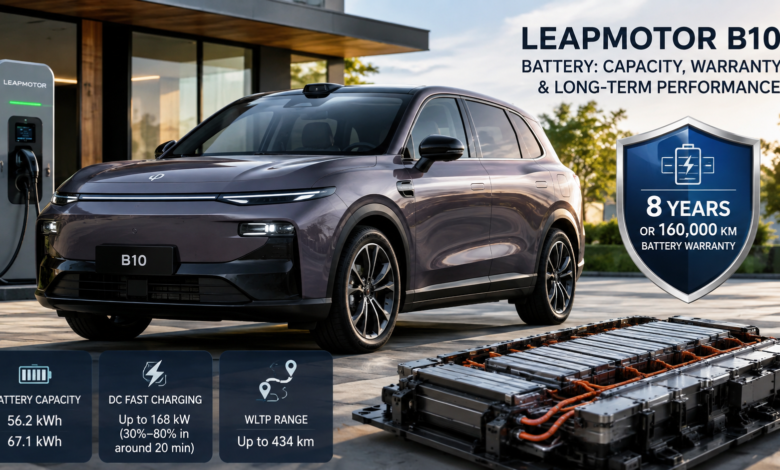
The leapmotor b10 battery is one of the most important parts of this electric SUV because it directly affects driving range, charging speed, running costs, and ownership confidence. The B10 is offered with two battery capacities depending on the market and trim: 56.2 kWh and 67.1 kWh. The larger pack can provide up to 434 km of WLTP range, while the smaller version is rated for up to 361 km under WLTP testing.
For buyers considering an electric vehicle for several years, battery capacity alone is not enough. Battery chemistry, thermal management, charging habits, warranty coverage, and real-world driving conditions all influence how well the pack performs over time. This guide explains what buyers should know about the B10 battery, including its capacity, warranty, charging capability, expected durability, and practical long-term considerations.
Leapmotor B10 Battery Capacity and Options
The leapmotor b10 battery comes in two main sizes. The entry-level configuration uses a 56.2 kWh pack, while the larger ProMax configuration uses a 67.1 kWh pack. Official European specifications list up to 361 km of WLTP range for the 56.2 kWh version and up to 434 km for the 67.1 kWh version.
The difference is significant for drivers who regularly travel longer distances. The 67.1 kWh version provides a larger energy reserve, which can reduce the frequency of charging stops on longer journeys. However, choosing the bigger battery is not automatically the best decision for everyone. A driver who mainly uses the B10 for commuting and urban driving may find the smaller pack sufficient.
The battery specification also varies by market. For example, some markets quote range using the NEDC testing cycle rather than WLTP. In Thailand, the B10 is listed with ranges of up to 442 km for the 56.2 kWh version and 516 km for the 67.1 kWh version under NEDC testing.
This difference demonstrates why buyers should not compare advertised range figures without checking the testing standard. WLTP figures are generally more useful for realistic comparisons than older NEDC figures, although actual range will still depend on driving conditions.
Battery Chemistry and Thermal Management
A major strength of the leapmotor b10 battery is its use of lithium iron phosphate (LFP) chemistry in markets where the specification identifies the battery type. The UK specification, for example, identifies the 67.1 kWh pack as an LFP battery.
LFP batteries are widely used in electric vehicles because they offer a combination of durability, thermal stability, and cost efficiency. They are also generally less dependent on nickel and cobalt than some other lithium-ion chemistries. That does not mean an LFP battery is immune to degradation, but it can be a sensible choice for an SUV designed for everyday use.
Thermal management is equally important. The B10 uses an advanced battery thermal-management system that monitors operating conditions and state of charge. Its battery uses liquid cooling to help maintain thermal stability.
This matters because battery temperature has a direct relationship with performance and degradation. Excessive heat can accelerate battery aging, while extremely cold conditions can temporarily reduce available performance and charging speed. A properly managed thermal system helps keep the battery within a more suitable operating range.
Charging Speed and Everyday Convenience
The leapmotor b10 battery supports 11 kW AC charging, while maximum DC charging power depends on the battery configuration. The 56.2 kWh version can accept up to 140 kW DC charging, while the 67.1 kWh version can reach up to 168 kW. Official specifications indicate that a 30% to 80% DC charge can take around 20 minutes under suitable conditions.
This is particularly useful for drivers who take long trips. Instead of waiting for a complete charge, a short rapid-charging session can add a substantial amount of usable range.
However, charging speed should be viewed as a maximum capability rather than a guarantee. Actual charging performance can vary with battery temperature, state of charge, charger capability, ambient temperature, and other factors. DC charging normally slows as the battery approaches a high state of charge, which is why the 30% to 80% window is more meaningful than quoting a theoretical peak speed.
For daily use, AC charging at home can be more convenient and gentler on the charging system. If the vehicle is plugged in overnight, many owners may rarely need to visit a public fast charger.
Leapmotor B10 Battery Warranty
Warranty coverage is an important consideration when evaluating the leapmotor b10 battery because battery replacement can be one of the most expensive potential repairs for an electric vehicle.
The battery warranty varies by market, so buyers should check the warranty document supplied with their vehicle. In several markets, the B10 is covered by an eight-year or 160,000 km high-voltage battery warranty, whichever comes first. For example, Leapmotor’s Malaysia launch information specifies eight years or 160,000 km for the battery, alongside a six-year or 150,000 km vehicle warranty.
The UK market uses a different mileage limit: the B10 has an eight-year or 100,000-mile battery warranty, while the standard vehicle warranty is four years or 60,000 miles.
These differences are important. A warranty advertised in one country should not automatically be assumed to apply in another market. Warranty conditions may also define what constitutes a battery defect, how capacity loss is assessed, and what exclusions apply.
Before purchasing, prospective owners should therefore ask the local dealer for the exact battery warranty terms, including any minimum battery-capacity guarantee and conditions relating to charging, servicing, or modifications.
Long-Term Battery Performance and Degradation
The long-term performance of the leapmotor b10 battery will depend on how the vehicle is used. No lithium-ion battery maintains exactly the same capacity forever. Gradual degradation is normal, meaning the amount of energy the battery can store will eventually decline.
For a typical owner, the most important issue is not whether degradation occurs, but how quickly it occurs and whether the remaining capacity continues to meet everyday needs. An owner who starts with more than enough range may barely notice moderate degradation, while someone who regularly drives close to the vehicle’s maximum range could notice the difference sooner.
Charging habits can also influence battery aging. Regularly relying on very high-power DC charging is not necessarily harmful when the vehicle is designed for it, but frequent rapid charging combined with high temperatures can place greater thermal demands on the battery. Whenever practical, routine home or workplace AC charging can be a sensible part of an everyday charging strategy.
It is also useful to avoid leaving an EV at an extremely high or extremely low state of charge for extended periods. Following the vehicle’s recommended charging settings and using scheduled charging can help owners manage battery use more efficiently.
Real-World Range: What Owners Should Expect
The advertised range of the leapmotor b10 battery should be treated as a testing reference rather than a guaranteed distance. Real-world range changes with speed, weather, traffic, road conditions, passenger load, tire pressure, heating or air conditioning, and driving style.
High-speed motorway driving generally consumes more energy than steady urban driving. Cold weather can also reduce temporary range because the battery and cabin require additional energy for thermal management and heating.
For example, a driver with a 67.1 kWh B10 might achieve results closer to the official rating during moderate conditions and efficient driving, while a driver traveling at sustained high speeds in extreme weather could see noticeably lower range.
This is normal for electric vehicles. A more useful approach is to judge whether the B10 offers enough usable real-world range for your normal routine, rather than expecting the dashboard or laboratory figure to remain constant in every situation.
Is the Battery Suitable for Long-Term Ownership?
From a technical perspective, the leapmotor b10 battery has several features that support long-term ownership. The use of LFP chemistry in specified versions, liquid cooling, battery thermal management, and a substantial battery warranty are all positive factors.
However, it is important not to confuse good engineering with proven decades-long reliability. The B10 is a relatively new model, so there is not yet a long history of high-mileage examples showing exactly how the battery will perform after 10 or 15 years.
That is one of the main uncertainties for early buyers. Battery technology itself is well established, but the specific combination of the B10’s battery pack, software, thermal system, charging strategy, and vehicle integration has had less time to accumulate long-term field data.
For buyers planning to keep the vehicle for many years, the local dealer network and availability of battery diagnostics may therefore be almost as important as the headline capacity.
Practical Ways to Protect Battery Health
Owners can take several straightforward steps to support the long-term condition of the leapmotor b10 battery. Using the manufacturer’s recommended charging limits is a good starting point. For regular daily driving, there is usually little reason to keep the battery at its highest possible state of charge unless the extra range is actually needed.
Avoiding prolonged exposure to extreme heat when the vehicle is sitting at a very high state of charge can also be sensible. Where possible, charging during cooler periods and using scheduled charging can reduce unnecessary thermal stress.
Drivers should also maintain correct tire pressure and avoid unnecessarily aggressive acceleration. Although these habits primarily improve energy efficiency, they can reduce the frequency of charging and help owners make better use of the available battery capacity.
Most importantly, owners should follow the vehicle’s service and software recommendations. Battery-management software plays an important role in monitoring the pack, balancing cells, managing temperature, and controlling charging behavior.
What Makes the B10 Battery Competitive?
The overall package makes the leapmotor b10 battery competitive in the affordable electric SUV segment. Buyers can choose between a smaller 56.2 kWh configuration and a larger 67.1 kWh version, while fast DC charging provides useful charging flexibility.
The larger battery is particularly attractive to drivers who prioritize range, while the smaller version can make sense for buyers focused on urban commuting. Both options provide the same basic electric powertrain concept, with a 160 kW motor and rear-wheel drive in the European technical specifications.
The bigger question is long-term ownership data. The technology looks promising, but real-world battery-health information from high-mileage B10 vehicles will become more valuable as the model spends more time on the road.
Conclusion
The leapmotor b10 battery offers a strong combination of capacity, charging performance, thermal management, and warranty protection. With 56.2 kWh and 67.1 kWh options, the B10 can suit both urban drivers and owners who need greater long-distance flexibility. The larger battery offers up to 434 km of WLTP range in current European specifications, while rapid DC charging can replenish 30% to 80% in about 20 minutes under suitable conditions.
The battery’s LFP chemistry and liquid thermal management are encouraging for durability, but buyers should remember that real-world longevity depends on climate, charging behavior, mileage, and vehicle usage. Warranty coverage is also market-specific, with several markets offering eight years or 160,000 km of battery protection.
Overall, the leapmotor b10 battery appears well suited to everyday electric driving, but its true long-term reputation will depend on how battery packs perform after years of ownership and high mileage. For buyers considering the B10, checking the local warranty terms and choosing the battery size that matches their actual driving needs are two of the smartest steps before purchase.
More EV Car Guides: Read more electric vehicle news, buying guides, reviews, and ownership tips on magazinerock.co.uk.
(FAQs)
How large is the Leapmotor B10 battery?
The B10 is offered with 56.2 kWh and 67.1 kWh battery options, depending on the market and trim. The 56.2 kWh version is rated for up to 361 km WLTP range, while the 67.1 kWh version can reach up to 434 km WLTP.
How long is the Leapmotor B10 battery warranty?
Battery warranty coverage depends on the market. Several markets provide eight years or 160,000 km, while the UK specification provides eight years or 100,000 miles. Buyers should confirm the exact local warranty terms before purchasing.
Does the B10 use an LFP battery?
Yes, the B10 uses LFP battery chemistry in specified versions and markets. The UK specification identifies the 67.1 kWh battery as lithium iron phosphate, a chemistry known for durability and thermal stability.
How quickly can the B10 battery charge?
The B10 supports up to 11 kW AC charging. Maximum DC charging is up to 140 kW for the 56.2 kWh version and 168 kW for the 67.1 kWh version. A 30% to 80% DC charge can take about 20 minutes under suitable conditions.
How can owners improve long-term battery performance?
Owners can support battery longevity by following the manufacturer’s recommended charging limits, avoiding unnecessary prolonged high states of charge, using AC charging for routine needs when convenient, maintaining appropriate tire pressure, and keeping the vehicle’s software and servicing up to date. Temperature management is also important because extreme heat and cold can affect battery performance.