Ultimate Guide to electric car battery recycling UK: How EV Battery Recycling Works
electric car battery recycling UK

Introduction
The rapid rise of electric vehicles has transformed the UK’s automotive industry, making cleaner transportation more accessible than ever. As more drivers switch to EVs, another important question has emerged: what happens to electric car batteries when they reach the end of their useful life? Understanding electric car battery recycling UK is essential for consumers, manufacturers, and policymakers who want to support a sustainable future.
Recycling these batteries not only reduces waste but also recovers valuable materials that can be reused in new battery production. With the UK aiming for greater environmental responsibility and reduced carbon emissions, efficient battery recycling has become a key part of the country’s circular economy. This guide explains how the recycling process works, why it matters, and what the future holds for the UK’s growing EV industry.
Why EV Battery Recycling Matters in the UK
Electric vehicle batteries are designed to last for many years, often between 10 and 15 years depending on driving habits, charging patterns, and environmental conditions. However, like all rechargeable batteries, they gradually lose their ability to hold a full charge. When their performance drops below the level required for efficient vehicle use, they are removed from service.
Rather than sending these batteries to landfill, the UK has developed systems that focus on responsible collection, testing, reuse, and recycling. This approach supports electric car battery recycling UK by ensuring that valuable raw materials remain in circulation instead of becoming waste.
Lithium-ion batteries contain materials such as lithium, nickel, cobalt, manganese, copper, aluminium, and graphite. Mining these resources requires significant energy and natural resources. Recovering them through recycling reduces environmental impact while helping manufacturers secure a more reliable supply of critical battery materials.
The growing popularity of electric vehicles means the number of retired batteries will increase steadily over the coming years. Preparing effective recycling infrastructure today ensures the UK can manage this future demand while supporting sustainability goals and reducing dependence on imported raw materials.
Another important reason battery recycling matters is environmental protection. Improper disposal of lithium-ion batteries can pose fire risks and may release harmful substances into the environment if damaged. Professional recycling facilities are specifically designed to handle these batteries safely, minimizing risks while recovering valuable resources for future manufacturing.
The UK’s commitment to cleaner transportation depends not only on producing more electric vehicles but also on managing every stage of a battery’s lifecycle responsibly. This makes electric car battery recycling UK an essential part of building a truly sustainable electric vehicle ecosystem.
How the EV Battery Recycling Process Works in the UK
The process of electric car battery recycling UK involves several carefully managed stages that are designed to maximize material recovery while ensuring safety. Since electric vehicle batteries contain high-voltage components and valuable metals, every step must follow strict environmental and safety standards.
When an electric vehicle battery reaches the end of its automotive life, it is first removed by trained professionals. The battery is then transported to an authorized recycling facility using specialized handling procedures. Safety is a top priority because damaged lithium-ion batteries can become unstable if handled incorrectly.
Battery Inspection and Assessment
Once the battery arrives at the recycling centre, technicians perform a detailed inspection. They assess its overall condition, remaining capacity, and structural integrity. Not every battery is immediately recycled. Some still retain enough storage capacity to serve in less demanding applications.
If the battery continues to perform well, it may be repurposed for a second life. For example, retired EV batteries can be used in renewable energy storage systems, commercial backup power solutions, or residential energy storage. Giving batteries a second life extends their usefulness and delays the need for full recycling.
When the battery is no longer suitable for reuse, it moves to the next stage of electric car battery recycling UK.
Safe Disassembly and Material Separation
The battery pack is carefully dismantled by trained specialists. This stage involves removing the protective casing, electrical wiring, cooling systems, and electronic components before accessing the battery modules and individual cells.
Modern battery packs are complex, and manufacturers use different designs. As a result, recycling facilities employ advanced equipment alongside skilled technicians to safely separate reusable materials.
Once dismantled, the different materials are sorted into categories such as steel, aluminium, copper, plastics, and electronic components. Each material follows its own recycling pathway, reducing waste and improving resource efficiency.
Recovering Valuable Raw Materials
The battery cells undergo specialized recycling methods to recover critical materials that can be reused in manufacturing.
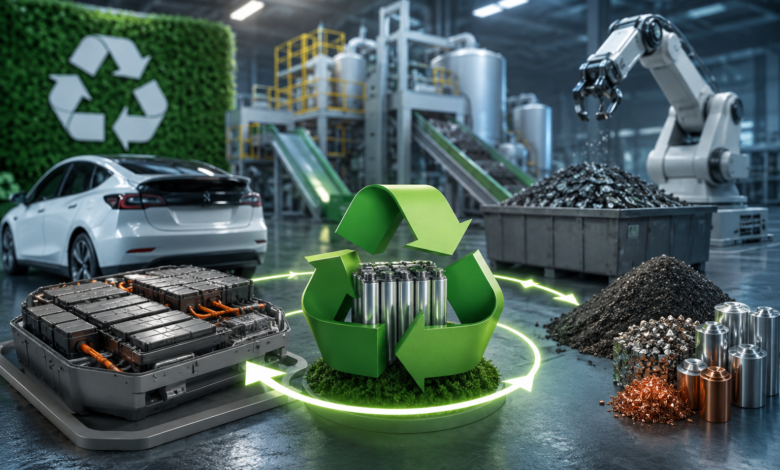
Mechanical processing is often the first step. Batteries are crushed under carefully controlled conditions to produce a material commonly known as “black mass.” This fine powder contains valuable metals including lithium, nickel, cobalt, manganese, and graphite.
The black mass is then treated using advanced recovery techniques. Depending on the recycling facility, processes may include hydrometallurgical or pyrometallurgical methods.
Hydrometallurgical recycling uses chemical solutions to separate and purify valuable metals with high recovery rates while consuming less energy. Pyrometallurgical recycling relies on high-temperature furnaces to extract metals from battery materials. Many modern UK recycling companies are investing in hydrometallurgical technologies because they offer greater efficiency and recover a wider range of valuable resources.
These recovered materials are refined into battery-grade products that can be used to manufacture new electric vehicle batteries, reducing the need for newly mined resources and strengthening the UK’s circular economy.
Quality Control and Reuse
Recovered materials are thoroughly tested to ensure they meet the quality standards required for battery production. High-purity lithium, nickel, cobalt, and other metals are supplied to manufacturers for use in new battery cells.
This closed-loop approach makes electric car battery recycling UK increasingly sustainable. Instead of treating used batteries as waste, the industry views them as valuable sources of raw materials that can support future electric vehicle production.
As recycling technologies continue to improve, recovery rates are expected to increase further, helping the UK reduce waste, lower production costs, and support long-term environmental goals.
Benefits and Challenges of EV Battery Recycling in the UK
As electric vehicle adoption continues to grow, electric car battery recycling UK is becoming increasingly important for both environmental protection and economic development. Recycling used EV batteries offers significant advantages, but the industry also faces several challenges that must be addressed to support long-term sustainability.
One of the biggest benefits is the conservation of natural resources. Electric vehicle batteries contain valuable materials such as lithium, nickel, cobalt, copper, and graphite. Extracting these minerals through mining requires large amounts of energy, water, and land. By recovering these materials from used batteries, recycling reduces the demand for new mining activities and helps preserve finite natural resources.
Another major advantage is the reduction of environmental impact. Manufacturing batteries from recycled materials generally produces fewer greenhouse gas emissions than using newly mined raw materials. As a result, electric car battery recycling UK supports the country’s climate goals and contributes to a lower-carbon economy.
Battery recycling also strengthens supply chain security. Global demand for battery materials has increased rapidly, creating concerns about shortages and price fluctuations. Recovering valuable metals within the UK allows manufacturers to reduce their reliance on imported resources while building a more resilient domestic battery industry.
Economic growth is another important benefit. As investment in battery recycling facilities increases, new employment opportunities are being created across engineering, manufacturing, logistics, research, and environmental management. These skilled jobs contribute to the UK’s growing green economy and encourage innovation in recycling technologies.
Despite these advantages, several challenges remain. One of the most significant is the wide variety of battery designs. Different vehicle manufacturers use different battery chemistries, sizes, and internal structures. This makes automated disassembly more difficult and increases the complexity of the recycling process.
Another challenge is the cost of recycling. Building and operating advanced recycling facilities requires substantial investment in specialized equipment, safety systems, and highly trained staff. Although technology is improving, recycling can still be more expensive than many traditional waste management processes.
Transportation also presents difficulties. Used lithium-ion batteries are classified as hazardous goods because damaged cells may present fire risks if not handled correctly. Strict packaging, storage, and transport regulations help reduce these risks but also increase operational costs for recycling companies.
The industry must also prepare for future demand. While many electric vehicle batteries are still in use today, the number reaching the end of their service life will rise significantly over the next decade. Expanding recycling capacity in advance will be essential to ensure that electric car battery recycling UK can manage this growing volume efficiently and responsibly.
Continued investment in research, improved battery design, and stronger collaboration between manufacturers, recyclers, and government agencies will help overcome these challenges. As technology advances, recycling processes are expected to become safer, faster, and more cost-effective, further strengthening the UK’s position as a leader in sustainable electric mobility.
The Future of EV Battery Recycling in the UK
The future of electric car battery recycling UK looks promising as the country continues to invest in cleaner transport and sustainable manufacturing. With the sale of electric vehicles increasing every year, the number of batteries reaching the end of their lifecycle will also grow. This creates both a challenge and an opportunity for the recycling industry.
Battery manufacturers are already designing products that are easier to dismantle and recycle. New battery technologies aim to improve material recovery rates while reducing recycling costs. At the same time, UK recycling companies are investing in advanced facilities capable of processing larger volumes of lithium-ion batteries with greater efficiency.
Artificial intelligence, robotics, and automated sorting systems are expected to play an increasingly important role in battery recycling. These technologies can identify battery types, improve disassembly accuracy, and recover valuable materials more quickly than traditional manual processes. As innovation continues, electric car battery recycling UK is likely to become even more efficient and environmentally friendly.
Government policies are also encouraging a circular economy in which manufacturers take greater responsibility for the entire lifecycle of electric vehicle batteries. This includes designing batteries for easier recycling, increasing the use of recycled materials in new products, and supporting investment in domestic recycling infrastructure.
Consumers also have an important role to play. Returning end-of-life batteries through authorised collection and recycling channels ensures valuable materials remain within the supply chain instead of becoming waste. Greater public awareness will help maximise the environmental and economic benefits of battery recycling across the UK.
Conclusion
Electric vehicles are transforming transportation, but their long-term sustainability depends on responsible battery management. Electric car battery recycling UK has become a vital part of the country’s transition to cleaner mobility by recovering valuable materials, reducing waste, and supporting the circular economy. Through careful collection, inspection, second-life applications, safe disassembly, and advanced material recovery, used batteries can be turned into valuable resources for future battery production.
Although the industry still faces challenges such as evolving battery designs, processing costs, and growing demand, ongoing investment and technological innovation continue to improve recycling efficiency. As the UK expands its electric vehicle market, electric car battery recycling UK will play an increasingly important role in protecting the environment, strengthening supply chains, and supporting a greener future for generations to come.
FAQs
Why is electric car battery recycling UK important?
Battery recycling helps recover valuable materials such as lithium, cobalt, nickel, copper, and graphite, reducing the need for new mining. It also minimises waste, lowers environmental impact, and supports a sustainable circular economy within the UK.
Can every electric vehicle battery be recycled?
Most electric vehicle batteries can be recycled, although the recovery process varies depending on the battery chemistry and design. Before recycling, many batteries are assessed to determine whether they can be reused in second-life energy storage applications.
What materials are recovered during battery recycling?
Recycling facilities commonly recover lithium, nickel, cobalt, manganese, copper, aluminium, steel, and graphite. These materials can be refined and reused to manufacture new batteries and other industrial products.
Are recycled battery materials suitable for making new EV batteries?
Yes. Modern recycling technologies can produce high-purity materials that meet manufacturing standards. These recovered resources help reduce dependence on newly mined materials while supporting the production of high-quality electric vehicle batteries.
What is the future of electric car battery recycling UK?
The future is expected to include more advanced recycling technologies, greater automation, improved battery designs, and increased investment in UK recycling facilities. These developments will improve recovery rates, lower environmental impact, and strengthen the country’s electric vehicle supply chain.
More EV Car Guides: Read more electric vehicle news, buying guides, reviews, and ownership tips on magazinerock.co.uk.




One Comment