Leapmotor T03 Battery: Capacity, Range & Replacement Cost Explained
Leapmotor T03 Battery

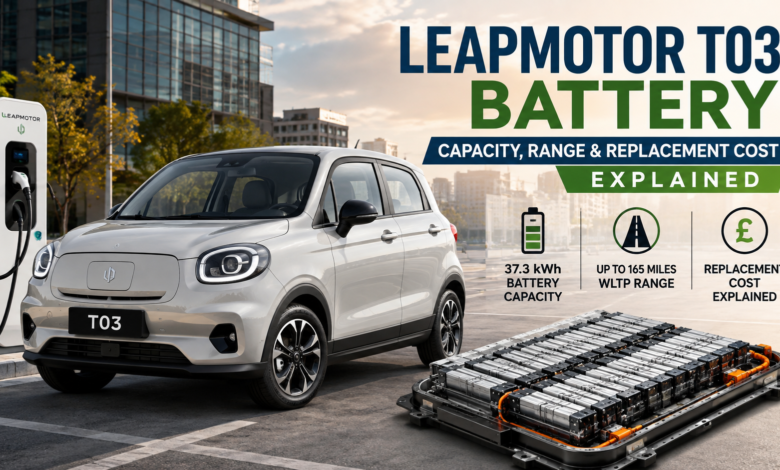
The leapmotor t03 battery is one of the most important reasons this compact electric car has attracted attention in the affordable EV market. With a 37.3 kWh battery pack, the T03 is designed primarily for urban and short-distance driving while still offering a useful official range for longer journeys. In the UK specification, Leapmotor quotes up to 165 miles of WLTP combined range, while real-world results can vary significantly with weather, speed, driving style and vehicle load.
Understanding the battery is particularly important if you are considering buying a T03, comparing it with another small electric car, or wondering how expensive it could be to maintain over several years. This guide explains the battery capacity, expected range, charging performance, battery technology, degradation, warranty coverage and what replacement could realistically cost.
Leapmotor T03 Battery Capacity and Technology
The current T03 specification uses a 37.3 kWh traction battery. Official technical information for the model lists the battery capacity at 37.3 kWh, with a 70 kW electric motor producing 95 hp and 158 Nm of torque. The battery is paired with front-wheel drive and is intended to provide a balance between low vehicle weight, efficiency and practical city range.
Battery capacity is measured in kilowatt-hours, or kWh. Put simply, a larger kWh figure generally means that an EV can store more energy, although capacity alone does not determine range. Aerodynamics, vehicle weight, tyres, temperature, driving speed and electrical consumption all influence how far the car can travel.
The T03’s battery is also relatively compact compared with the much larger packs found in family-sized electric cars. That is appropriate for an A-segment city car because carrying a very large battery would add unnecessary weight and cost for drivers who mainly travel short distances.
Some published technical specifications identify the T03’s battery chemistry as LFP, or lithium iron phosphate. LFP batteries are valued for their durability, thermal stability and ability to tolerate frequent charging cycles. However, battery chemistry can vary by market or production specification, so buyers should confirm the exact battery specification for their individual vehicle.
How Much Range Does the Leapmotor T03 Battery Provide?
The official WLTP combined range for the current UK T03 is up to 165 miles, equivalent to roughly 265 kilometres. Leapmotor also quotes a significantly higher urban-cycle figure in some specifications because city driving at lower speeds can be much more efficient than sustained high-speed motorway driving.
However, WLTP should not be treated as a guaranteed everyday driving distance. Real-world range can be lower, particularly during cold weather or when travelling at motorway speeds. Independent EV range estimates also show substantial variation depending on temperature and driving conditions.
For example, a driver travelling around town at moderate speeds may get considerably more kilometres from the same battery charge than someone driving continuously at motorway speeds. Heating or air conditioning can also increase electricity consumption.
This is why the most useful way to judge the leapmotor t03 battery is to consider your normal journey rather than relying only on the headline WLTP figure. For commuting, school runs, shopping and other urban trips, the battery can provide a comfortable operating range. For frequent long motorway journeys, charging stops and higher energy consumption become more important considerations.
Charging the Leapmotor T03 Battery
Charging performance is another major part of the T03 ownership experience. The car has a 6.6 kW onboard AC charger, while its DC fast-charging capability allows substantially quicker charging when a compatible public charger is available. Published specifications give a DC charging time of around 36 minutes for a 30% to 80% charge, with maximum DC charging power listed around the mid-40 kW range depending on market specification.
For everyday use, home charging is generally more convenient than relying on rapid chargers. If the vehicle is parked overnight, an AC charging setup can replenish a substantial portion of the battery while the owner is asleep.
Fast charging is more useful during longer journeys. Instead of waiting for the battery to reach 100%, EV drivers commonly charge to a higher percentage when needed and continue their journey. Charging from 30% to 80% can also be considerably quicker than charging from a low state of charge to completely full.
Battery charging habits can influence long-term battery health. Occasional fast charging is normal, but drivers who want to maximise long-term battery condition may prefer slower AC charging for routine use and follow the manufacturer’s charging recommendations.
Leapmotor T03 Battery Lifespan and Degradation
One of the biggest concerns for prospective EV owners is battery degradation. Like all rechargeable batteries, an EV battery gradually loses some of its original energy-storage capacity over time. This does not mean the battery suddenly stops working after a certain number of years.
Instead, degradation normally occurs gradually. A vehicle with a healthy battery may continue to provide useful range long after the warranty period begins to approach its end. The actual rate depends on factors such as climate, mileage, charging behaviour, battery temperature and how the vehicle is used.
The T03’s LFP battery specification can be advantageous from a durability perspective, although battery longevity should never be judged by chemistry alone. The battery management system also plays an important role by monitoring operating conditions and helping maintain the battery within appropriate limits. Leapmotor says the T03 uses an intelligent battery management system to monitor battery operation and temperature.
For owners, sensible charging habits are more important than trying to avoid every possible fast charge. Keeping the vehicle maintained, following the manufacturer’s recommendations and avoiding unnecessary extreme battery conditions are practical ways to support long-term battery health.
Leapmotor T03 Battery Warranty
Battery warranty coverage is especially important because the traction battery is one of the most expensive components in an EV. Warranty terms vary by market, model year and vehicle specification, so buyers should always check the warranty documentation supplied with their particular T03.
For example, published Leapmotor information in several markets lists 8 years or 160,000 km for the high-voltage battery. Leapmotor Australia’s current warranty information gives an eight-year/160,000 km battery warranty, while European T03 specifications also list the same duration and mileage limit.
The warranty does not necessarily mean that every reduction in battery capacity is automatically covered. Warranty conditions can specify particular defects, thresholds or exclusions. Therefore, a driver should distinguish between normal battery degradation and an actual battery fault.
This distinction matters when buying a used T03. Before purchasing, it is sensible to ask for the vehicle’s warranty documents, service history and any available battery-health information.
How Much Does a Leapmotor T03 Battery Replacement Cost?
The replacement cost is one of the most difficult questions to answer with a single number because Leapmotor does not publish one universal retail replacement price for the complete high-voltage battery pack across all markets.
A full battery replacement can involve more than the battery cells themselves. The final bill may include the battery pack, transportation, diagnostic work, installation, software or system checks and labour. Local taxes, dealer pricing, availability and exchange rates can also make a significant difference.
Some reports from China have cited replacement costs of around 50,000 yuan for a Leapmotor T03 battery pack, but this should not be treated as a worldwide official price. Parts availability, vehicle generation and local labour costs can change the final amount substantially.
There is also an important difference between replacing an entire battery pack and repairing a battery fault. If a problem is limited to a particular component or module and the manufacturer or qualified repairer supports component-level repair, the cost may be much lower than installing a complete replacement pack.
For this reason, owners should not assume that a reduction in range automatically means the entire battery needs replacement. A proper diagnostic assessment should come first.
Is Replacing the Leapmotor T03 Battery Worth It?
Whether a battery replacement makes financial sense depends heavily on the vehicle’s age, condition, market value and replacement quotation.
Suppose an older T03 has lost some range but remains reliable and the battery is still functioning normally. In that situation, replacement may not be necessary at all. Reduced capacity is expected as a battery ages, and the car can continue to be useful for shorter journeys.
A replacement becomes more relevant if the battery has suffered a serious fault, has lost an unusually large amount of usable capacity, or has developed a problem that prevents the vehicle from operating normally. If the vehicle is still covered by the battery warranty and the issue meets the warranty conditions, the financial calculation can be very different.
This is where a professional battery health test becomes valuable. Rather than judging battery condition from the dashboard range estimate alone, owners should ask for a proper diagnostic assessment and determine the battery’s state of health.
Practical Tips to Protect the T03 Battery
The easiest way to protect the leapmotor t03 battery is to treat it as an expensive long-term component rather than something that needs constant attention.
For everyday driving, home AC charging can be a convenient option. Drivers should also follow the charging limits and recommendations provided by Leapmotor instead of relying on generic EV advice that may not apply to every software or battery configuration.
Extreme temperatures can affect EV performance and temporary range. In cold conditions, energy consumption may increase because the car needs additional energy for cabin heating and battery-related thermal management. Similarly, high-speed driving can reduce range because aerodynamic resistance rises quickly as speed increases.
Tyre pressure is another simple but often overlooked factor. Underinflated tyres increase rolling resistance and can reduce efficiency. Keeping tyres correctly inflated therefore helps both range and general vehicle safety.
Most importantly, don’t replace a battery simply because the estimated range is lower than when the car was new. Range is affected by weather, driving style and recent energy consumption. A proper battery diagnostic test is a much better indicator of battery condition.
The Overall Value of the Leapmotor T03 Battery
The T03’s battery is well matched to the vehicle’s intended role. A 37.3 kWh pack provides a useful balance between size, weight, cost and driving range, while the official 165-mile WLTP figure makes the car practical for many urban and suburban drivers.
Its limitations are equally important. Drivers who regularly travel long distances at high motorway speeds may find the real-world range considerably lower than the official figure. The relatively modest DC charging capability also means that the T03 is not designed to compete with larger EVs that can accept much higher charging power.
For city-focused drivers, however, those limitations may be less significant. A smaller battery can be perfectly adequate when daily journeys are short and charging is available at home or work.
Conclusion
The leapmotor t03 battery is a compact 37.3 kWh pack designed around the needs of an affordable urban electric car. Its official WLTP range of up to 165 miles gives the T03 useful everyday flexibility, while AC and DC charging options make regular and occasional longer-distance driving practical.
Battery degradation is normal, but it does not automatically mean that the pack needs replacing. Warranty protection can cover qualifying battery faults, with several published market specifications providing coverage of up to eight years or 160,000 km.
Replacement costs are harder to predict because there is no single worldwide retail price for a complete T03 traction battery. Reported figures should therefore be treated as market-specific indications rather than guaranteed dealer prices. The smartest approach is to obtain a battery health diagnosis and an official repair or replacement quotation before making a major financial decision.
More EV Car Guides: Read more electric vehicle news, buying guides, reviews, and ownership tips on magazinerock.co.uk.
(FAQs)
What is the capacity of the Leapmotor T03 battery?
The current T03 uses a 37.3 kWh battery in published European and UK specifications. The battery works with a 70 kW electric motor producing 95 hp and 158 Nm of torque.
How far can the Leapmotor T03 travel on one charge?
The UK T03 is officially rated for up to 165 miles of WLTP combined range, or approximately 265 km. Actual range can be lower or higher depending on speed, temperature, traffic, driving style, vehicle load and climate-control use.
How long does it take to charge the T03 battery?
The T03 has a 6.6 kW AC onboard charger. Its DC fast-charging system can charge the battery from approximately 30% to 80% in around 36 minutes under the specified conditions. Charging time can vary with charger capability, battery temperature, starting state of charge and other factors.
How long does the Leapmotor T03 battery last?
There is no single guaranteed lifespan because battery degradation depends on mileage, climate, charging behaviour and usage. However, published Leapmotor warranty information in several markets provides battery coverage for up to 8 years or 160,000 km, whichever comes first.
How much does it cost to replace a Leapmotor T03 battery?
There is no universal official replacement price that applies to every country. Reported figures can vary considerably depending on the market, parts availability, labour and whether the complete pack or only a faulty component needs attention. One Chinese report cited approximately 50,000 yuan for a T03 battery replacement, but this should not be used as a worldwide price. The best approach is to obtain a diagnostic assessment and an official local quotation before deciding on replacement.