Revolutionary EV Battery Technology 2026 Explained: A Complete Guide to the Future of Electric Vehicles
EV battery technology 2026

Introduction
The rapid evolution of EV battery technology 2026 is transforming the future of electric mobility. With automakers investing billions of dollars in research and development, today’s battery innovations are delivering longer driving ranges, faster charging times, improved safety, and lower production costs than ever before. As governments worldwide encourage cleaner transportation and consumers demand more efficient electric vehicles, battery technology has become the driving force behind this revolution. Understanding EV battery technology 2026 helps buyers, enthusiasts, and industry professionals make informed decisions while gaining insight into where the electric vehicle market is headed over the next decade.
Latest Advancements in EV Battery Technology
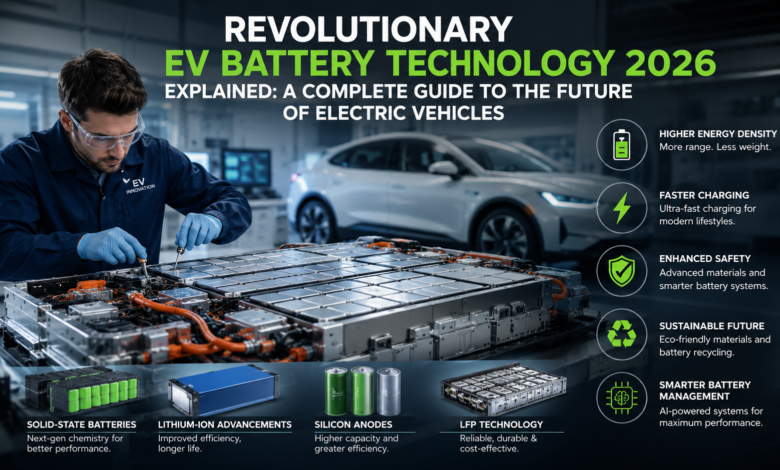
Electric vehicle batteries have advanced significantly over the past few years. Modern manufacturers are moving beyond traditional lithium-ion chemistry and exploring next-generation solutions that improve efficiency, lifespan, and sustainability. These developments are shaping EV battery technology 2026 into one of the most exciting innovations in the automotive industry.
One of the biggest breakthroughs is the growing adoption of solid-state batteries. Unlike conventional lithium-ion batteries that use liquid electrolytes, solid-state batteries utilize solid electrolytes to enhance safety and energy density. This design minimizes the risk of overheating while enabling vehicles to travel considerably farther on a single charge.
Battery manufacturers are also refining lithium iron phosphate (LFP) batteries. Although these batteries generally offer slightly lower energy density than nickel-based alternatives, they provide longer cycle life, improved thermal stability, and reduced manufacturing costs. These advantages make LFP batteries increasingly attractive for affordable electric vehicles.
Silicon-enhanced anodes represent another promising advancement. Replacing a portion of traditional graphite with silicon allows batteries to store more energy within the same physical space. As production techniques improve, silicon anodes are expected to become a standard feature in future battery packs.
Artificial intelligence is also playing a vital role in battery management systems. Intelligent software continuously monitors battery health, charging behavior, and temperature to optimize performance while extending battery lifespan. These smart systems help drivers maximize efficiency without compromising safety.
Another notable trend is improved battery recycling. Manufacturers are investing in closed-loop recycling systems that recover valuable materials such as lithium, cobalt, nickel, and copper. This approach reduces environmental impact while strengthening supply chains for future battery production.
The ongoing progress in battery chemistry, manufacturing, and software demonstrates why EV battery technology 2026 is expected to deliver better performance and greater value for consumers across every vehicle segment.
Why EV Battery Technology Matters More Than Ever
Battery technology determines nearly every aspect of an electric vehicle’s performance. Driving range, charging speed, reliability, maintenance costs, safety, and resale value all depend on the quality of the battery system.
Consumers often evaluate electric vehicles based on how far they can travel between charges. Recent improvements in battery energy density allow manufacturers to install lighter batteries capable of storing more electricity. This translates into longer driving ranges without increasing vehicle weight.
Charging convenience has also become a major priority. Advanced battery designs now support ultra-fast charging capabilities that significantly reduce waiting times. Many next-generation batteries are engineered to handle repeated fast charging with less degradation than earlier generations.
Safety remains equally important. Modern battery packs include sophisticated cooling systems, protective casings, and intelligent monitoring software that reduce the likelihood of thermal runaway. Combined with improved battery chemistry, these technologies make today’s electric vehicles safer than ever before.
Cost reduction is another key objective. Battery production accounts for a substantial portion of an electric vehicle’s total price. Manufacturers continue refining production methods, improving manufacturing efficiency, and reducing dependence on expensive raw materials. As battery costs decline, electric vehicles become more accessible to mainstream consumers.
Durability has improved considerably as well. Many modern batteries are designed to retain a high percentage of their original capacity after thousands of charging cycles. This longer lifespan increases owner confidence and lowers the overall cost of vehicle ownership.
The continued progress in EV battery technology 2026 demonstrates that batteries are no longer simply components—they are the foundation of electric transportation.
Battery Types Powering the Future of Electric Vehicles
Several battery chemistries are competing to define the next generation of electric mobility. Each offers unique strengths depending on vehicle requirements, cost targets, and driving conditions.
Lithium-Ion Batteries
Lithium-ion batteries continue to dominate the electric vehicle market due to their excellent balance of energy density, reliability, and mature manufacturing processes. Continuous improvements in cell design and thermal management are extending their capabilities year after year.
Solid-State Batteries
Solid-state batteries are widely considered one of the most promising developments in EV battery technology 2026. Their solid electrolytes improve safety while increasing energy density, allowing manufacturers to build lighter batteries with longer driving ranges. Although large-scale production remains challenging, commercial adoption is steadily approaching.
Lithium Iron Phosphate (LFP) Batteries
LFP batteries have gained remarkable popularity because they offer exceptional durability and thermal stability. Their lower production costs make them particularly suitable for entry-level electric vehicles and commercial fleets where long battery life is a priority.
Sodium-Ion Batteries
Sodium-ion batteries are emerging as an affordable alternative for specific applications. Sodium is more abundant than lithium, helping reduce supply chain concerns and manufacturing expenses. While energy density currently trails lithium-ion batteries, continued research is improving their competitiveness.
Lithium-Sulfur Batteries
Lithium-sulfur technology remains under development but offers the potential for significantly higher energy density than conventional batteries. Researchers continue addressing challenges related to lifespan and stability before widespread commercialization becomes feasible.
As research accelerates across multiple battery chemistries, EV battery technology 2026 is expected to offer consumers more choices tailored to different budgets, driving habits, and performance expectations.
Charging Innovations and Smart Battery Management
Charging technology has advanced alongside battery development, making electric vehicles more practical for everyday use. One of the defining features of EV battery technology 2026 is the combination of high-performance batteries with intelligent charging systems that reduce downtime and improve long-term reliability.
Ultra-fast DC charging is becoming increasingly common across modern EV platforms. Many new battery packs are designed to accept higher charging rates while maintaining stable temperatures and minimizing battery degradation. Under favorable conditions, some next-generation electric vehicles can recover hundreds of kilometers of driving range in less than 20 minutes. This improvement helps address one of the biggest concerns for potential EV buyers—charging time.
Battery management systems (BMS) have also become far more sophisticated. These systems continuously monitor voltage, temperature, charging speed, and individual cell performance. If any irregularity is detected, the software automatically adjusts charging or power delivery to protect the battery. This intelligent approach extends battery life, improves efficiency, and enhances overall vehicle safety.
Thermal management is another area where manufacturers continue to innovate. Modern liquid-cooling systems maintain optimal battery temperatures in both hot and cold climates. Stable operating temperatures improve charging performance, preserve battery capacity, and reduce wear over time. As a result, vehicles equipped with advanced cooling systems deliver more consistent performance throughout the year.
Bidirectional charging is gaining attention as another exciting advancement. Instead of simply drawing electricity from the grid, compatible electric vehicles can also supply stored energy back to homes, businesses, or even the electrical grid. This capability allows EVs to serve as temporary energy storage during power outages or periods of high electricity demand.
Wireless charging technology is also progressing. Although it is not yet widespread, several manufacturers are testing inductive charging systems that allow drivers to recharge their vehicles by parking over specially designed charging pads. As efficiency improves and infrastructure expands, wireless charging could become a convenient feature in future electric vehicles.
Together, these innovations demonstrate how EV battery technology 2026 is improving not only battery performance but also the entire ownership experience.
Challenges and the Future of EV Battery Technology
Despite remarkable progress, several challenges remain before electric vehicle batteries reach their full potential. Addressing these issues will determine how quickly the global transition to electric mobility continues.
Raw material availability remains one of the industry’s biggest concerns. Lithium, nickel, cobalt, and graphite are essential components in many battery chemistries. As global demand for electric vehicles grows, manufacturers are working to diversify supply chains, improve mining practices, and reduce dependence on scarce materials through alternative battery chemistries.
Battery recycling is becoming increasingly important. Millions of electric vehicles sold today will eventually require battery replacement or recycling. Modern recycling technologies can recover valuable materials for reuse, reducing waste while lowering demand for newly mined resources. Closed-loop recycling systems are expected to play a major role in the future sustainability of the EV industry.
Production costs continue to decline, but affordability remains a challenge for many consumers. Advances in manufacturing automation, improved battery chemistry, and economies of scale are expected to reduce battery prices further over the coming years. Lower battery costs will help make electric vehicles accessible to a broader range of buyers.
Cold-weather performance also continues to receive attention. Batteries naturally lose efficiency at lower temperatures, affecting both driving range and charging speed. Manufacturers are addressing this issue through enhanced battery chemistry, improved insulation, and more effective thermal management systems.
Looking ahead, researchers are exploring breakthrough technologies that could redefine EV battery technology 2026 and beyond. Solid-state batteries are approaching commercial production, while lithium-sulfur, sodium-ion, and other advanced chemistries continue to show significant promise. Artificial intelligence, digital battery monitoring, and predictive maintenance will further optimize battery health and extend operational life.
Industry experts expect battery energy density to continue increasing while charging times decrease. Future battery packs will likely become lighter, safer, more recyclable, and less expensive, accelerating the global adoption of electric vehicles across passenger, commercial, and industrial transportation sectors.
As governments strengthen emissions regulations and consumers prioritize sustainability, battery innovation will remain the foundation of the electric mobility revolution. The continued evolution of EV battery technology 2026 reflects not only technological advancement but also a broader commitment to cleaner, more efficient transportation.
Conclusion
The future of electric mobility depends heavily on continuous battery innovation, and EV battery technology 2026 represents a major step forward in that journey. Advances in solid-state batteries, lithium iron phosphate technology, silicon-enhanced anodes, intelligent battery management systems, and ultra-fast charging are making electric vehicles more practical, affordable, and reliable than ever before. At the same time, improvements in battery recycling, manufacturing efficiency, and sustainability are helping create a cleaner automotive ecosystem.
Although challenges such as raw material supply, production costs, and cold-weather performance still exist, ongoing research and industry investment continue to deliver practical solutions. For consumers, businesses, and policymakers alike, understanding EV battery technology 2026 provides valuable insight into the future of transportation. As innovation continues at a rapid pace, electric vehicles will become even more capable, efficient, and accessible, making battery technology the true engine of tomorrow’s sustainable mobility
More EV Car Guides: Read more electric vehicle news, buying guides, reviews, and ownership tips on magazinerock.co.uk.
FAQs
What is EV battery technology 2026?
EV battery technology 2026 refers to the latest generation of electric vehicle battery innovations expected to shape the market in 2026. It includes advancements such as solid-state batteries, improved lithium-ion cells, LFP batteries, silicon anodes, advanced battery management systems, and faster charging technologies that enhance vehicle performance, safety, and efficiency.
Are solid-state batteries better than lithium-ion batteries?
Solid-state batteries offer several advantages over conventional lithium-ion batteries, including higher energy density, improved safety, faster charging potential, and longer lifespan. However, lithium-ion batteries remain the most widely used technology because they are currently more affordable and easier to manufacture at scale.
How long do modern EV batteries typically last?
Most modern electric vehicle batteries are designed to last between 10 and 20 years, depending on driving habits, charging practices, climate, and battery chemistry. Many manufacturers also provide long-term battery warranties, giving consumers added confidence in battery durability.
Can EV batteries be recycled?
Yes. Modern EV batteries can be recycled to recover valuable materials such as lithium, nickel, cobalt, copper, and aluminum. Battery recycling helps reduce environmental impact, conserves natural resources, and supports the sustainable growth of the electric vehicle industry.
What are the biggest benefits of the latest EV battery technologies?
The latest battery technologies provide longer driving range, faster charging, improved safety, lower maintenance requirements, greater energy efficiency, longer battery life, and reduced manufacturing costs. These improvements make electric vehicles increasingly practical and affordable for everyday drivers while supporting a more sustainable transportation future.