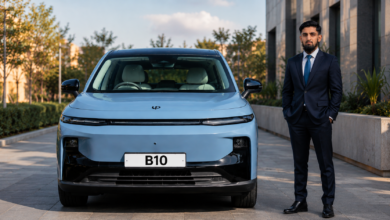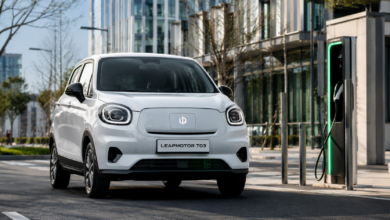
The leapmotor b05 tax position is one of the most attractive aspects of this new electric hatchback for UK company-car drivers. The B05 is a fully electric family hatchback with a 67.1kWh battery, around 300 miles of claimed WLTP range and a UK on-the-road price of £30,495 before Leapmotor’s initial £1,500 discount. More importantly for business users, it carries a 4% Benefit-in-Kind (BIK) rate for the 2026/27 tax year, placing it firmly in the low-tax electric vehicle category.
For private buyers, the calculation is different. Instead of BIK, the main tax considerations include Vehicle Excise Duty (VED), insurance, electricity, servicing and depreciation. Understanding the difference is essential because a car that looks inexpensive to buy can have a very different overall cost depending on whether it is privately owned or supplied through an employer.
What Is the Leapmotor B05 Tax Position in the UK?
The B05 is a zero-emission battery-electric vehicle, so its company-car tax treatment is based on the government’s percentage for fully electric cars rather than the higher rates normally applied to petrol or diesel vehicles.
For the 2026/27 tax year, the B05 has a 4% BIK rate. Leapmotor’s UK pricing information lists a P11D value of approximately £30,430, although the exact figure used by an employer’s payroll or tax calculation should always be checked against the vehicle’s official P11D information.
The basic BIK calculation is straightforward:
P11D value × BIK percentage = taxable company-car benefit
Using £30,430 as the P11D value:
£30,430 × 4% = £1,217.20 taxable benefit
That £1,217.20 is not the amount the employee pays. Instead, it is the amount added to the employee’s taxable income for company-car purposes. The actual tax depends on the individual’s marginal income-tax rate.
This makes the B05 particularly relevant to employees who want an electric company car without taking on the much larger tax bill associated with a conventional high-emission vehicle.
How Much Is Leapmotor B05 Company Car Tax?
The most useful way to understand the leapmotor b05 tax calculation is to look at what different taxpayers could actually pay.
At a P11D value of £30,430 and a 4% BIK rate, the taxable benefit is £1,217.20 per year.
A basic-rate taxpayer paying 20% income tax would therefore pay approximately £243.44 per year, or about £20.29 per month.
A higher-rate taxpayer paying 40% would pay approximately £486.88 per year, equivalent to around £40.57 per month.
An additional-rate taxpayer paying 45% would pay approximately £547.74 per year, or roughly £45.65 per month.
These figures are illustrations rather than personalised tax advice. Actual payroll deductions can vary according to an employee’s circumstances, tax code and whether the car is available for private use for the full tax year.
The important point is that the B05’s low percentage makes the taxable benefit relatively small compared with the car’s purchase price. HMRC confirms that zero-emission cars have a 4% appropriate percentage for 2026/27.
Why the B05 Could Be Attractive as a Company Car
For employees considering an electric company car, the leapmotor b05 tax advantage goes beyond the headline 4% figure.
The B05 has a relatively modest P11D value compared with many larger electric SUVs and premium EVs. Its standard UK specification also includes equipment such as a panoramic roof, heated seats, 19-inch alloy wheels, driver-assistance technology and a 12-speaker audio system. The combination of equipment and low BIK percentage could make it particularly interesting for salary-sacrifice and company-car schemes.
There is another important consideration: the B05 does not have a conventional fuel benefit charge because it is fully electric. HMRC also states that electricity is not treated as fuel for the company-car fuel-benefit rules.
If an employer provides workplace charging or certain charging arrangements, the tax treatment can therefore be more favourable than drivers may expect from traditional company-car rules.
Leapmotor B05 Tax Rates Will Rise in Future Years
One mistake prospective company-car users should avoid is assuming that today’s 4% rate will remain unchanged throughout ownership.
The UK government has already legislated future increases for zero-emission company cars. The rate rises to 5% in 2027/28, then to 7% in 2028/29 and 9% in 2029/30.
Using the same illustrative £30,430 P11D value, a 5% rate would create a taxable benefit of £1,521.50. At 40% income tax, that would mean approximately £608.60 of annual company-car tax.
At 7%, the taxable benefit would be £2,130.10, producing approximately £852.04 of annual tax for a 40% taxpayer.
At 9%, the taxable benefit would reach £2,738.70, equivalent to approximately £1,095.48 in annual tax at the same 40% rate.
Even after these increases, the B05 is likely to remain considerably cheaper in BIK terms than many comparable petrol, diesel and higher-emission company cars. However, the future rate increases should be included when comparing a three- or four-year company-car agreement.
What About Vehicle Excise Duty on the Leapmotor B05?
Electric cars are no longer completely exempt from Leapmotor B05 Tax. Since 1 April 2025, electric vehicles have been brought into the VED system.
For electric cars registered on or after 1 April 2025, the first-year VED rate is £10, followed by the standard rate. For 2026/27, the standard rate is £200 per year.
The B05 does, however, sit comfortably below the current expensive-car-supplement threshold for zero-emission vehicles. From 1 April 2026, the threshold for the additional VED charge on qualifying zero-emission cars is more than £50,000, while the B05’s listed on-the-road price is £30,495.
That means buyers should not expect the B05 to attract the expensive-car supplement simply because it is an electric vehicle.
Leapmotor B05 Running Costs: Charging and Energy
Tax is only one part of ownership. The leapmotor b05 tax calculation may look appealing, but running costs will depend heavily on how and where the car is charged.
The B05 uses a 67.1kWh battery and has an official WLTP range of about 300 miles. Real-world range will vary according to temperature, driving speed, weather, traffic, heating or air-conditioning use and driving style.
For company-car mileage calculations, HMRC’s advisory electricity rates from June 2026 are 7p per mile for home charging and 15p per mile for public charging. These rates are designed for business mileage calculations and should not be confused with the exact retail price a private driver pays for electricity.
For example, 10,000 business miles at the 7p home-charging advisory rate would equate to £700 of electricity cost for mileage purposes. At 15p per mile using the public-charging rate, the equivalent would be £1,500.
This highlights why drivers who can charge mainly at home may achieve substantially lower day-to-day energy costs than drivers who depend heavily on public rapid chargers.
Servicing, Insurance and Other Ownership Costs
Electric vehicles generally have fewer moving mechanical components than internal-combustion cars, which can reduce some maintenance requirements. The B05 also comes with a four-year/60,000-mile vehicle warranty and an eight-year/100,000-mile battery warranty according to Leapmotor’s UK information.
However, EV ownership does not mean maintenance is free. Tyres, brakes, suspension components, air-conditioning systems, wipers and other consumables still require attention. Insurance can also vary considerably between drivers, locations, age groups and insurers.
Depreciation is another major running-cost factor. Because the B05 is a relatively new model in the UK market, its long-term residual value is not yet established to the same degree as more mature competitors. That uncertainty matters particularly to private buyers and businesses evaluating whole-life costs.
Is the Leapmotor B05 Better for Business or Private Buyers?
The answer depends on how the car will be acquired.
For a company-car user, the leapmotor b05 tax position is a major selling point. The 4% BIK rate in 2026/27 can produce a comparatively small personal tax bill, particularly for a higher-rate taxpayer who would otherwise choose a petrol or diesel vehicle with a much higher appropriate percentage.
For a private buyer, the calculation is less straightforward. There is no BIK saving because there is no company-car benefit. Instead, the buyer needs to consider the purchase price, finance interest, insurance, VED, charging, servicing and eventual resale value.
Businesses also have their own tax considerations. Current UK rules continue to provide incentives for qualifying zero-emission company expenditure, including a 100% first-year capital allowance for qualifying zero-emission cars, with the allowance currently extended for expenditure within the relevant period to 31 March 2027 for Corporation Tax purposes.
That means employers should assess the B05 from both the employee’s and company’s perspective rather than looking only at the monthly BIK deduction.
The Bigger Picture for B05 Ownership Costs
The strongest argument for the B05 is not simply that it is electric. It is the combination of a relatively accessible price, substantial standard equipment, a claimed 300-mile WLTP range and a low initial company-car tax rate. Leapmotor has positioned the car at £30,495 on the road, with an introductory £1,500 LEAP-GRANT reducing the retail price to £28,995 under the stated offer.
There are nevertheless challenges. Public charging can be significantly more expensive than home charging, insurance costs are unpredictable, and future BIK rates will gradually reduce some of the tax advantage. The UK is also changing how electric vehicles are taxed over the longer term, so buyers should not assume today’s tax environment will remain unchanged.
From April 2028, the government plans to introduce a new mileage-based Electric Vehicle Excise Duty system for battery-electric, plug-in hybrid and hydrogen cars.
For that reason, a genuine whole-life-cost comparison should consider at least three to four years of ownership rather than focusing solely on the first year’s tax.
Conclusion
The leapmotor b05 tax position makes this electric hatchback particularly interesting for UK company-car drivers. In 2026/27, its 4% BIK rate combined with a P11D value of around £30,430 produces a taxable benefit of roughly £1,217, resulting in an illustrative annual tax bill of about £243 for a 20% taxpayer or £487 for a 40% taxpayer.
The B05 also benefits from relatively manageable VED, no expensive-car supplement at its current price, and potentially low charging costs when home electricity is used efficiently. However, future BIK increases to 5%, 7% and 9% mean that buyers should examine the complete ownership period rather than relying on the introductory 4% figure.
Overall, the leapmotor b05 tax advantage is strongest for employees receiving the car through a company-car or salary-sacrifice arrangement. Private buyers should look beyond tax and compare depreciation, finance, insurance, charging and maintenance before deciding whether the B05 represents the right long-term value.
More EV Car Guides: Read more electric vehicle news, buying guides, reviews, and ownership tips on magazinerock.co.uk.
(FAQs)
Is the Leapmotor B05 a low-tax company car in the UK?
Yes. For the 2026/27 tax year, the B05 has a 4% Benefit-in-Kind rate because it is a zero-emission electric car. This can make its company-car tax significantly lower than many petrol and diesel alternatives.
How much BIK tax could I pay on a Leapmotor B05?
Using an illustrative P11D value of £30,430 and a 4% BIK rate, the taxable benefit is £1,217.20. A 20% taxpayer would pay about £243 a year, while a 40% taxpayer would pay about £487.
Does the Leapmotor B05 pay road tax?
Yes. Electric cars are now subject to VED in the UK. For 2026/27, a qualifying electric car registered from 1 April 2025 pays £10 for its first year and then the standard £200 rate.
Will Leapmotor B05 company-car tax increase?
Yes. The zero-emission BIK rate is scheduled to rise from 4% in 2026/27 to 5% in 2027/28, 7% in 2028/29 and 9% in 2029/30.
Is the B05 cheaper to run than a petrol car?
It can be, particularly when most charging takes place at home. Electricity costs, insurance, tyres, depreciation and charging location all affect the final result, so the cheapest option depends on individual mileage and ownership circumstances.