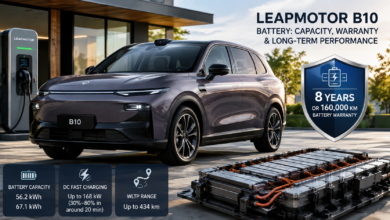
Leapmotor Battery Warranty Explained: Complete Guide to Coverage, Duration & Key Terms
Leapmotor Battery Warranty

Introduction
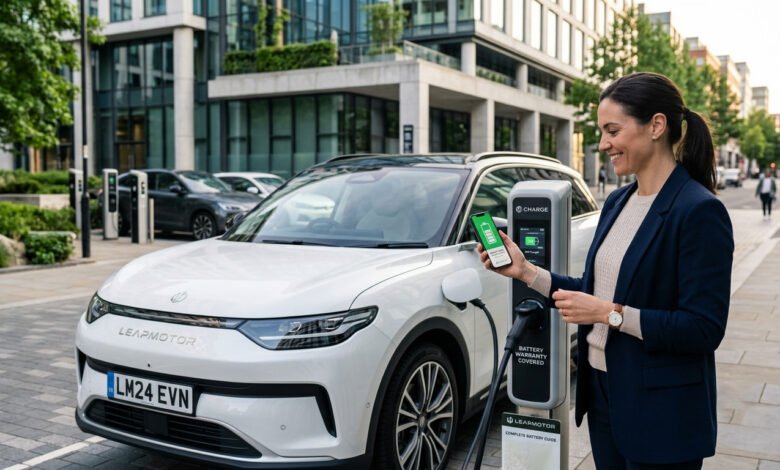
Leapmotor Battery Warranty is one of the most important ownership considerations when buying one of the Chinese EV manufacturer’s electric cars. While range, charging speed and technology often grab the headlines, the battery is the single most valuable component in an electric vehicle. Understanding what the warranty covers—and just as importantly, what it doesn’t—can help buyers make a more informed decision.
Whether you’re considering a new Leapmotor for personal use, adding EVs to a company fleet, or buying a used example, this guide explains the available battery warranty information, what battery degradation means in practice, and the factors that could affect warranty eligibility.
Quick Answer
Leapmotor vehicles sold in Europe generally include a dedicated high-voltage battery warranty that is separate from the vehicle’s standard warranty. The exact duration and conditions can vary by market and model, so buyers should always confirm the official warranty booklet supplied with their local distributor. Battery warranties typically protect against manufacturing defects and excessive capacity loss within specified conditions rather than normal ageing.
At-a-Glance Summary
| Feature | Details |
|---|---|
| Battery warranty | Separate from vehicle warranty |
| Covers | Manufacturing defects in the high-voltage battery |
| Capacity guarantee | Check model-specific documentation, as conditions may vary by market |
| Normal battery ageing | Not usually considered a warranty fault |
| Transferability | Often transferable with the vehicle, subject to manufacturer terms |
| Best practice | Follow servicing and maintenance requirements to preserve coverage |
What Does the Leapmotor Battery Warranty Cover?
The Leapmotor Battery Warranty is designed to protect owners against defects in the high-voltage battery that arise from manufacturing or material faults during the warranty period.
Depending on the model and market, the warranty may include protection for:
- High-voltage battery pack
- Battery control systems
- Internal battery components
- Manufacturing defects
- Unexpected battery failures caused by defective parts
The battery warranty exists independently from the vehicle’s standard warranty because the battery is both technically complex and significantly more expensive than conventional vehicle components.
For most buyers, this means that if the battery develops an issue caused by a manufacturing defect within the warranty terms, the manufacturer may repair or replace the affected components.
Does the Leapmotor Battery Warranty Cover Battery Degradation?
This is one of the most misunderstood aspects of EV ownership.
All lithium-ion batteries gradually lose capacity over time. That process is expected and is not, by itself, considered a defect.
Many EV manufacturers specify a minimum battery health threshold during the warranty period. If battery capacity falls below that threshold under the stated conditions, a warranty claim may be possible.
Important: At the time of writing, publicly available European documentation does not consistently specify a single battery capacity retention figure across all Leapmotor models and markets. Buyers should therefore rely on the official warranty documentation supplied with their vehicle rather than assuming a universal percentage applies.
What Is Usually Not Covered?
Like most EV manufacturers, Leapmotor is unlikely to treat every battery-related issue as a warranty claim.
Common exclusions typically include:
- Normal battery ageing
- Cosmetic damage
- Accident damage
- Flood or fire damage
- Unauthorised battery modifications
- Damage caused by improper repairs
- Use outside manufacturer recommendations
- Deliberate misuse or neglect
These exclusions are common across the automotive industry and are intended to distinguish manufacturing faults from external damage or improper use.
Why Battery Warranties Matter
For most EV owners, the battery represents the largest single replacement cost.
A comprehensive battery warranty provides reassurance by reducing financial risk during the early years of ownership.
It can also improve:
- resale value
- buyer confidence
- fleet planning
- long-term ownership costs
For fleet operators in particular, predictable warranty support helps reduce uncertainty when estimating whole-life vehicle costs.
Practical Ownership Considerations
The battery warranty is only one part of the ownership picture.
Drivers should also think about how they use the vehicle.
Daily Urban Driving
Frequent short journeys generally place relatively little stress on modern battery systems, especially when supported by thermal management.
Motorway Driving
Sustained high-speed motorway travel increases energy consumption but does not necessarily affect warranty coverage. However, repeated rapid charging on long journeys may contribute to faster battery ageing over many years, although modern battery management systems are designed to minimise this.
Winter Conditions
Cold weather temporarily reduces available range because lithium-ion batteries operate less efficiently at low temperatures.
This temporary reduction should not be confused with permanent battery degradation.
Looking After Your Battery
Owners can help maximise battery longevity by following sensible charging habits.
Good practice includes:
- Avoid leaving the battery at 100% charge for extended periods unless required for a journey.
- Avoid repeatedly allowing the battery to remain completely discharged.
- Use DC rapid charging when needed rather than for every charge.
- Install software updates when available.
- Follow the manufacturer’s recommended servicing schedule.
These habits are widely recommended across the EV industry and can help maintain long-term battery health, regardless of warranty coverage.
How Does Leapmotor Compare With Other EV Manufacturers?
| Manufacturer | Separate Battery Warranty | Notes |
|---|---|---|
| Leapmotor | Yes | Confirm exact market-specific terms |
| Tesla | Yes | Model-dependent coverage |
| Hyundai | Yes | Model-dependent coverage |
| Kia | Yes | Model-dependent coverage |
| MG | Yes | Market-specific terms |
| BYD | Yes | Model-dependent coverage |
Rather than focusing solely on warranty length, buyers should also compare:
- capacity retention guarantees
- warranty exclusions
- service network
- battery repair availability
- software support
- roadside assistance
A longer warranty is only valuable if the conditions are clear and practical.
Does the Warranty Transfer to a New Owner?
Battery warranties are often transferable with the vehicle for the remainder of the warranty period, provided the vehicle continues to meet the manufacturer’s conditions.
However, transfer rules can differ between countries and distributors.
Anyone buying a used Leapmotor should verify:
- original registration date
- remaining warranty period
- service history
- outstanding recalls
- official warranty eligibility
Should the Battery Warranty Influence Your Buying Decision?
Yes—but it should not be the only deciding factor.
A battery warranty offers peace of mind, particularly for buyers intending to keep the vehicle for several years.
However, it should be considered alongside:
- real-world driving range
- charging performance
- efficiency
- public charging compatibility
- software updates
- dealer support
- ownership costs
- overall vehicle reliability
A strong warranty cannot compensate for poor aftersales support or limited servicing availability.
Expert Verdict
The Leapmotor Battery Warranty provides an important layer of protection for one of the vehicle’s most valuable components. While the exact warranty terms may differ between models and European markets, buyers should focus on more than just the headline duration.
Read the official warranty documentation carefully, understand what constitutes normal battery ageing, and confirm any battery capacity guarantee before purchasing. For fleet buyers and private owners alike, those details can have a greater impact than the warranty length alone.
If you’re buying a new Leapmotor through an authorised retailer, asking for the complete warranty booklet before signing the order is one of the simplest ways to avoid misunderstandings later.
Conclusion
The Leapmotor Battery Warranty is a key consideration for anyone purchasing one of the brand’s electric vehicles. It helps protect against manufacturing defects in the high-voltage battery, but it does not eliminate normal battery ageing or cover every type of damage. Before buying, confirm the exact terms for your chosen model and market, especially any battery capacity retention guarantee and transferability conditions.
Best for: Private EV buyers seeking reassurance, fleet managers evaluating long-term ownership costs, and used EV buyers checking remaining coverage.
May not suit: Buyers who assume every reduction in battery capacity is covered under warranty or who are unwilling to follow the manufacturer’s maintenance requirements.
More EV Car Guides: Read more electric vehicle news, buying guides, reviews, and ownership tips on magazinerock.co.uk.
(FAQs)
How long is the Leapmotor Battery Warranty?
The duration depends on the specific model and the country where the vehicle is sold. Always check the official warranty documentation provided by your authorised retailer, as European markets may have different terms.
Does the Leapmotor Battery Warranty cover battery degradation?
Not all capacity loss is covered. Normal battery ageing is expected with lithium-ion batteries. Warranty protection may apply if battery performance falls below the manufacturer’s specified threshold, where one is stated for your model and market.
Can I transfer the battery warranty when selling my Leapmotor?
In many cases, yes. The remaining battery warranty is often transferable with the vehicle, although eligibility depends on the manufacturer’s terms and whether the vehicle has been maintained in accordance with its requirements.
What could invalidate the battery warranty?
Examples may include unauthorised modifications, improper repairs, accident damage, misuse, or failure to follow the manufacturer’s maintenance requirements. Refer to the official warranty booklet for the full list of exclusions.
Is the battery warranty separate from the vehicle warranty?
Yes. The high-voltage battery is normally covered by a dedicated battery warranty, while the rest of the vehicle is covered by the standard manufacturer warranty.