Tesla vs BYD UK: The Ultimate Winner in 2026 – Which EV Brand Is Better?
Tesla vs BYD UK

Introduction
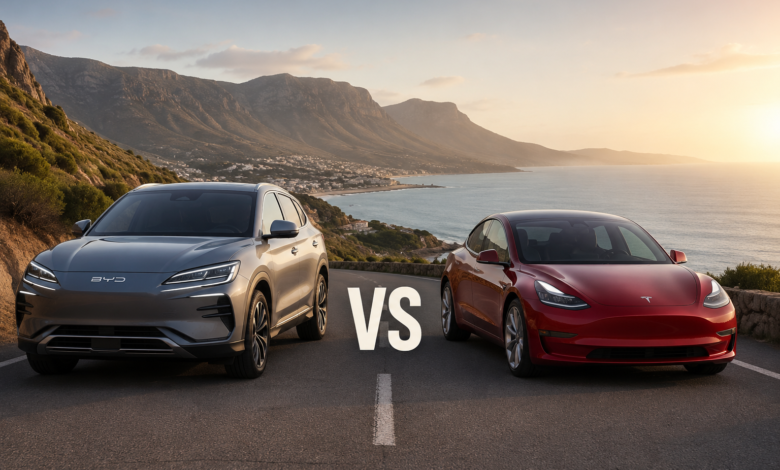
The debate around Tesla vs BYD UK has become more relevant than ever in 2026 as electric vehicles continue to reshape the British automotive market. Buyers are no longer choosing between petrol and electric cars—they are comparing two of the world’s most influential EV manufacturers. Tesla has built its reputation on innovation, software, and charging infrastructure, while BYD has rapidly expanded with competitive pricing, advanced battery technology, and an increasingly attractive model lineup. If you are planning to buy an electric car this year, understanding the strengths and weaknesses of both brands will help you make a confident decision. This detailed comparison explores performance, technology, pricing, reliability, ownership experience, and overall value to determine which brand deserves your attention.
Understanding the Growing Competition Between Tesla and BYD
The global electric vehicle industry has entered a new phase of competition. For years, Tesla dominated conversations around EV innovation, but BYD has emerged as one of the fastest-growing electric vehicle manufacturers worldwide. In the UK, this rivalry has become increasingly important as more buyers look for practical, affordable, and technologically advanced electric cars.
The discussion surrounding Tesla vs BYD UK is not simply about sales numbers. It reflects changing customer priorities. Buyers now expect excellent driving range, rapid charging, modern safety features, smart software, and long-term reliability without paying a premium unless the value is clear.
Tesla continues to focus on a software-first approach. Features such as over-the-air updates, intelligent navigation, advanced driver assistance, and a highly connected driving experience remain some of its strongest selling points. The company also benefits from years of experience in producing electric vehicles specifically designed around battery technology rather than adapting traditional petrol platforms.
BYD has taken a different approach by combining advanced engineering with aggressive pricing. The company manufactures many of its own batteries and components, allowing it to maintain competitive prices while delivering impressive quality. This level of vertical integration gives BYD greater control over production costs and supply chains, making it a serious competitor in today’s EV market.
For many UK buyers, the choice in the Tesla vs BYD UK comparison depends on balancing innovation with affordability.
Price and Overall Value for UK Buyers
Price is often one of the biggest deciding factors when purchasing an electric vehicle. While Tesla remains a premium brand in many respects, its pricing strategy has become more competitive over recent years. Models like the Tesla Model 3 and Model Y continue to attract buyers looking for strong performance, excellent efficiency, and cutting-edge technology.
BYD, however, has gained attention by offering electric vehicles that deliver impressive specifications at more accessible price points. Models such as the Dolphin, Atto 3, and Seal provide generous equipment levels, comfortable interiors, and modern technology without requiring buyers to stretch their budgets.
When comparing Tesla vs BYD UK, overall ownership costs deserve as much attention as the initial purchase price. Running costs for both brands are significantly lower than those of traditional petrol or diesel vehicles because electricity is generally cheaper than fuel, and electric cars require less routine maintenance.
Insurance premiums may vary depending on the specific model, driving history, and location, but Tesla’s higher repair costs can sometimes result in more expensive insurance compared with similar BYD models. On the other hand, Tesla vehicles often retain strong resale values thanks to their established reputation and continued consumer demand.
Government incentives, company car tax benefits, and lower vehicle operating expenses also influence total ownership costs. Business users in particular continue to benefit from favourable taxation policies that encourage EV adoption across the UK.
Ultimately, buyers focused primarily on affordability may find BYD particularly attractive, while those prioritising advanced software, ecosystem integration, and long-term resale value may still lean towards Tesla.
Battery Technology and Driving Range
Battery technology lies at the heart of every electric vehicle, and this is where both manufacturers demonstrate impressive engineering expertise.
Tesla has spent years refining battery efficiency. Rather than simply increasing battery size, Tesla focuses on improving energy management, aerodynamics, software optimisation, and drivetrain efficiency. As a result, many Tesla models achieve excellent real-world driving range while maintaining strong performance.
BYD has earned widespread recognition for its Blade Battery technology. Designed with safety, durability, and longevity in mind, the Blade Battery has become one of the company’s defining innovations. It offers excellent thermal stability and is engineered to reduce the risk of battery damage under extreme conditions.
The Tesla vs BYD UK comparison becomes especially interesting when considering real-world driving rather than laboratory figures. Tesla often delivers highly competitive motorway efficiency, making long-distance travel convenient for frequent commuters. BYD vehicles also perform well in everyday urban and mixed driving conditions, providing dependable range that satisfies the needs of most families.
Charging infrastructure is another important consideration. Tesla owners benefit from seamless integration with the extensive Supercharger network, making long journeys remarkably straightforward. Although public charging networks across the UK continue to expand rapidly, Tesla’s charging ecosystem remains one of its greatest competitive advantages.
BYD supports fast charging through the UK’s growing public charging infrastructure, and compatibility with widely available charging providers continues to improve. For drivers who mainly charge at home overnight, the difference between the two brands may be less significant than for those who regularly travel long distances.
As battery technology continues to evolve in 2026, both manufacturers remain committed to improving charging speeds, battery lifespan, and energy efficiency. Buyers evaluating Tesla vs BYD UK should consider not only official range figures but also their own driving habits, access to charging facilities, and expected ownership period.
Performance, Technology, and Driving Experience
Performance has always been one of Tesla’s strongest selling points. Even its entry-level models offer quick acceleration, responsive steering, and a driving experience that feels modern and engaging. Tesla’s electric motors deliver instant torque, making city driving and motorway overtaking effortless. Combined with a low center of gravity created by the battery placement, Tesla vehicles offer impressive stability and confident handling.
When comparing Tesla vs BYD UK, performance is no longer a one-sided competition. BYD has made remarkable progress in developing electric vehicles that deliver smooth acceleration, refined ride quality, and excellent everyday usability. Models such as the BYD Seal have demonstrated that the company can compete directly with established premium EV manufacturers in terms of driving dynamics.
Tesla’s software ecosystem remains a major differentiator. Regular over-the-air updates continuously improve vehicle performance, navigation, entertainment, and driver assistance features without requiring dealership visits. This ability to enhance a vehicle after purchase adds long-term value and keeps Tesla owners up to date with new features.
BYD also offers a modern infotainment system with large touchscreens, smartphone connectivity, voice controls, and intelligent driver assistance technologies. While its software continues to improve, Tesla still maintains an advantage in user interface design, ecosystem integration, and software maturity.
For drivers who prioritize cutting-edge technology and a highly connected ownership experience, Tesla remains an excellent choice. Those seeking balanced performance with practical everyday comfort may find BYD equally appealing.
Interior Quality, Safety, and Reliability
Interior design reflects the different philosophies of both manufacturers. Tesla embraces minimalism with clean dashboards, premium materials, and a central touchscreen controlling most vehicle functions. Some drivers appreciate this futuristic approach, while others prefer more physical buttons for frequently used controls.
BYD adopts a more traditional yet modern interior layout. Soft-touch materials, ergonomic seating, thoughtful storage spaces, and user-friendly controls create a welcoming cabin that appeals to a broad range of buyers. Many reviewers have praised BYD for offering excellent interior quality considering its competitive pricing.
Safety is a key consideration in the Tesla vs BYD UK comparison. Tesla vehicles are equipped with advanced safety systems, including collision avoidance technology, automatic emergency braking, adaptive cruise control, lane-keeping assistance, and multiple active safety features. Their structural design has consistently earned strong safety ratings.
BYD places equal emphasis on occupant protection. Its latest models include comprehensive driver assistance systems, multiple airbags, blind-spot monitoring, rear cross-traffic alerts, intelligent parking assistance, and robust battery protection. The company’s Blade Battery technology also contributes to enhanced safety through improved thermal stability.
Reliability remains an important factor for long-term ownership. Tesla has made significant improvements in manufacturing quality over recent years, although some owners still report occasional fit-and-finish inconsistencies. BYD has developed a reputation for solid build quality and dependable engineering, supported by extensive experience in battery manufacturing.
Maintenance requirements for both brands are generally lower than those of conventional petrol or diesel vehicles because electric drivetrains contain fewer moving parts. However, the availability of service centers, replacement parts, and customer support may vary depending on location within the UK.
Which Brand Offers Better Value in 2026?
Choosing between Tesla vs BYD UK depends largely on your priorities, budget, and driving habits.
If your focus is on industry-leading software, exceptional charging convenience, impressive resale value, and an innovative ownership experience, Tesla continues to justify its premium reputation. Frequent long-distance travelers may also benefit from the convenience of Tesla’s well-developed charging ecosystem.
BYD stands out as an outstanding value proposition for buyers seeking affordability without sacrificing quality. Its competitive pricing, advanced battery technology, comfortable interiors, generous standard equipment, and growing reputation make it an increasingly attractive option for families, commuters, and first-time EV buyers.
Business users should also consider company car taxation, expected annual mileage, and total cost of ownership. In many cases, both manufacturers provide substantial savings compared with traditional internal combustion vehicles due to lower running costs and reduced maintenance requirements.
From an expert perspective, the Tesla vs BYD UK comparison no longer has a universally correct answer. Instead, it reflects two different approaches to electric mobility. Tesla leads in software innovation and ecosystem integration, while BYD excels in value, manufacturing efficiency, and accessible electric transportation.
As the UK EV market continues to evolve, both brands are expected to introduce new models, improved battery technologies, and enhanced charging capabilities. This ongoing competition ultimately benefits consumers by driving innovation and increasing choice.
Conclusion
The debate over Tesla vs BYD UK in 2026 highlights just how far the electric vehicle industry has progressed. Tesla continues to impress with advanced software, powerful performance, efficient energy management, and one of the most convenient charging networks available. BYD, meanwhile, has established itself as a serious competitor by delivering high-quality electric vehicles with competitive pricing, innovative battery technology, strong safety features, and excellent everyday practicality.
For technology enthusiasts and drivers who value a connected driving experience, Tesla remains an outstanding choice. For buyers looking for exceptional value, dependable engineering, and lower purchase costs, BYD presents an equally compelling alternative.
Ultimately, the best decision in the Tesla vs BYD UK comparison depends on your individual needs, budget, and driving lifestyle. Both manufacturers represent the future of electric mobility, and either can provide a rewarding ownership experience in 2026.
FAQs
Which brand offers better value in the Tesla vs BYD UK comparison?
BYD generally offers better value for buyers seeking competitive pricing, generous standard features, and advanced battery technology. Tesla, however, delivers premium software, strong resale value, and an industry-leading charging experience that many drivers consider worth the higher price.
Is Tesla still the leader in electric vehicle technology?
Tesla remains a leader in software development, over-the-air updates, intelligent navigation, and charging infrastructure. However, BYD has made significant advances in battery innovation and vehicle engineering, making the technology gap much smaller than it was a few years ago.
Which brand has the better battery technology?
Both companies produce highly capable battery systems. Tesla focuses on efficiency and long driving range, while BYD’s Blade Battery is widely recognized for its safety, durability, and long-term reliability. The better option depends on individual driving requirements.
Are BYD electric vehicles reliable for UK drivers?
Yes. BYD has earned a growing reputation for dependable engineering, quality manufacturing, and consistent battery performance. As its UK presence expands, service support and customer confidence are expected to continue improving.
Should I choose Tesla or BYD in 2026?
If you prioritize software innovation, charging convenience, and premium performance, Tesla is an excellent choice. If affordability, strong equipment levels, practical design, and advanced battery technology are your main priorities, BYD offers outstanding value. Comparing your budget, driving habits, and ownership expectations will help you choose the vehicle that best fits your needs.
More EV Car Guides: Read more electric vehicle news, buying guides, reviews, and ownership tips on magazinerock.co.uk.


2 Comments