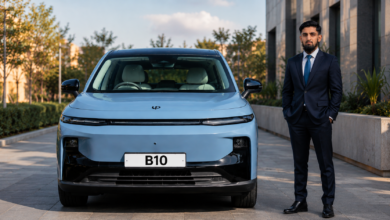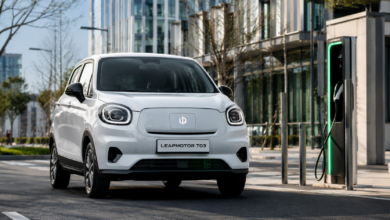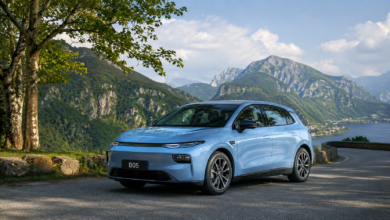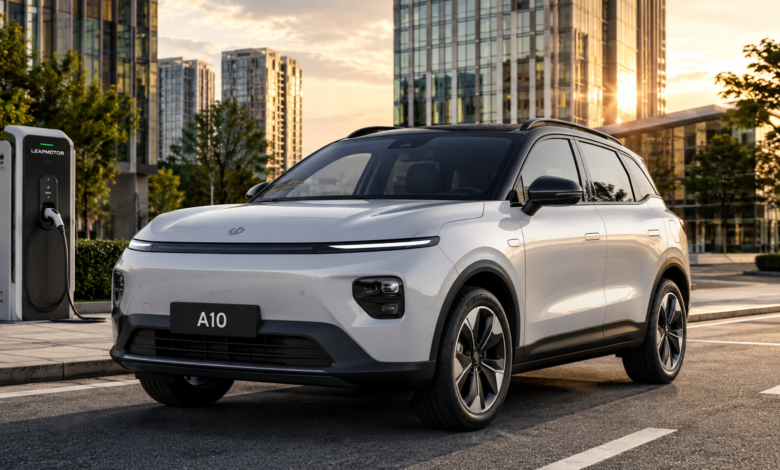
The leapmotor a10 is one of the most closely watched compact electric SUVs of 2026. Built on Leapmotor’s new A platform, it combines a small urban-friendly footprint with a claimed 505 km CLTC range, modern cabin technology and optional LiDAR-assisted driver support.
It launched in China in March 2026, while the same model is marketed internationally as the B03X. With affordability becoming increasingly important in the EV market, the model arrives at a time when buyers want more technology without moving into premium pricing.
What Is the Leapmotor A10?
The leapmotor a10 is a five-seat battery-electric compact SUV aimed primarily at drivers who want the practicality of a crossover without the size of a larger family SUV. It is around 4,270 mm long, 1,810 mm wide and 1,635 mm high, with a 2,605 mm wheelbase.
Leapmotor describes the vehicle as the first model developed on its new global A platform. Its exterior follows the company’s Technology Natural Aesthetics 2.0 design language, using a closed front section, slim lighting and clean surfaces rather than the large grilles associated with conventional petrol SUVs. The result is a distinctly modern electric-car appearance.
Battery, Range and Charging
One of the main attractions of the leapmotor a10 is the choice of battery sizes. Chinese-market versions use either a 39.8 kWh battery with a claimed 403 km CLTC range or a 53 kWh battery with a claimed 505 km range.
The 505 km figure is impressive for a vehicle in this class, but buyers should understand what it means. CLTC is a Chinese testing cycle and is not directly equivalent to WLTP or real-world driving. Highway speeds, cold weather, heating or air conditioning, passenger weight, traffic and driving style can all reduce the distance available between charges.
Charging is another strong point. The larger battery can reportedly go from 30% to 80% in about 16 minutes under suitable conditions. That can make quick top-ups much more convenient for drivers who regularly travel beyond the city.
For mainly urban use, the smaller battery may be sufficient and can reduce purchase weight and cost. Drivers who commute longer distances or frequently take road trips are more likely to benefit from the 53 kWh version.
Performance and Driving Experience
The leapmotor a10 is designed around efficiency rather than outright performance. Higher-output versions use a front-mounted electric motor producing about 90 kW and 150 Nm of torque. The listed top speed is 160 km/h, while the 505 km versions have a reported 0–100 km/h time of roughly 10.6 seconds.
The figures point to an everyday driving character rather than a performance focus. Electric torque should still make city acceleration responsive.
Front-wheel drive also suits the vehicle’s purpose. It keeps the powertrain relatively straightforward and can support efficient packaging. For most urban and family buyers, ride comfort, steering feel, braking behaviour and visibility will matter more than a quick acceleration time.
Interior, Technology and Practicality
Technology is a major part of the leapmotor a10 proposition. Depending on trim, the vehicle can use advanced Qualcomm computing hardware, a large central infotainment display and more sophisticated driver-assistance equipment. Higher specifications can also include LiDAR.
LiDAR is useful because it gives an advanced driver-assistance system another method of detecting objects and road surroundings. However, it should not be interpreted as autonomous driving. The driver remains responsible for the vehicle, and the performance of assistance features depends on software, sensors, road conditions and local regulations.
The compact exterior dimensions are also relevant to everyday usability. A shorter SUV can be easier to park and manoeuvre, while a 2,605 mm wheelbase provides a reasonable foundation for passenger space. For families, however, the most important practical questions will be rear-seat comfort, luggage capacity, storage, child-seat access and visibility.
Price and Market Position
The leapmotor a10 launched in China with four main versions priced from RMB 65,800 to RMB 86,800. That places it firmly in the value-oriented section of the Chinese EV market.
Those figures should not be treated as a direct prediction for overseas pricing. Export models can become considerably more expensive because of taxes, tariffs, shipping, certification, distributor costs and differences in standard equipment. International buyers should therefore judge the car using the final local price rather than converting the Chinese list price.
Leapmotor’s relationship with Stellantis is also important to its international strategy. The partnership can help the brand expand distribution and reach markets that would be difficult to serve through a smaller independent network. That could become a meaningful advantage if the model receives a broad international rollout.
Why It Could Matter to EV Buyers
The model arrives as competition in the affordable electric SUV segment becomes more intense. Consumers increasingly expect a useful driving range, smartphone-style interfaces, driver assistance and fast charging even from smaller vehicles.
Its significance goes beyond its individual specifications. If Leapmotor can offer sophisticated electronics and practical electric range at a competitive price, established manufacturers may face greater pressure to improve equipment or reduce prices.
There is also a consumer benefit from having more choices. Buyers can compare battery capacity, range, charging performance, equipment and ownership costs instead of choosing between only a small number of compact EVs.
Challenges Buyers Should Consider
The model still has several areas that potential buyers should investigate. Local availability is one of them. A vehicle can be highly competitive in China but have a different value proposition after international taxes, tariffs and equipment changes are applied.
Real-world range is another consideration. A 505 km CLTC claim is useful for understanding the Chinese specification, but it should not be treated as a guaranteed daily distance. Independent tests in different climates and at motorway speeds will provide a more useful picture for buyers.
After-sales support also matters. Modern electric vehicles depend heavily on software for infotainment, connectivity, diagnostics and driver assistance. A strong specification is less convincing if updates are slow or service coverage is limited.
Finally, resale value remains difficult to predict for a relatively young EV brand. Established manufacturers may have an advantage in used-car recognition, although strong reliability and competitive pricing could help Leapmotor build buyer confidence over time.
Is It Worth Watching?
For someone shopping for a compact electric SUV, this EV has a compelling specification on paper. The combination of two battery choices, up to 505 km of claimed CLTC range, rapid charging, modern computing hardware and available LiDAR gives it a broad appeal.
The key is to look beyond headline numbers. Compare local price, warranty, battery coverage, charging access, insurance, servicing, software support and expected resale value. These factors shape the true cost of ownership.
The model is particularly interesting for urban families and commuters who want an SUV driving position without stepping up to a large, expensive vehicle.
Conclusion
The leapmotor a10 reflects the changing priorities of the affordable EV market: compact dimensions, practical electric range, fast charging and increasingly advanced software and driver-assistance technology. Its 403 km and 505 km CLTC options give buyers flexibility, while the larger battery and rapid charging capability make the vehicle more suitable for longer journeys.
Its ultimate success will depend on factors that specifications cannot fully show, including reliability, safety performance, software quality, local pricing and after-sales support. If Leapmotor delivers strongly in those areas, the A10 could become a significant contender in the compact electric SUV segment.
For buyers considering an EV in 2026, the leapmotor a10 deserves close attention, especially once local specifications, independent range tests and ownership data become widely available.
More EV Car Guides: Read more electric vehicle news, buying guides, reviews, and ownership tips on magazinerock.co.uk.
(FAQs)
What is the Leapmotor A10?
The leapmotor a10 is a five-seat compact battery-electric SUV developed on Leapmotor’s A platform. Outside China, the vehicle is known as the B03X.
What range does it offer?
Depending on battery and trim, the leapmotor a10 has claimed CLTC ranges of 403 km and 505 km. Actual range will vary with weather, speed, traffic, temperature and driving style.
How quickly can it charge?
The 53 kWh version can reportedly charge from 30% to 80% in around 16 minutes under suitable conditions. Charging speed can vary according to the charger, battery temperature and state of charge.
Does it offer LiDAR?
Selected versions include LiDAR for advanced driver assistance. This technology can improve environmental sensing, but it does not make the vehicle fully autonomous and does not remove the driver’s responsibility.
What is its Chinese-market price?
The leapmotor a10 launched in China from RMB 65,800, with the top listed version priced at RMB 86,800. Overseas prices can differ substantially because of taxes, tariffs, distribution costs and local specifications.