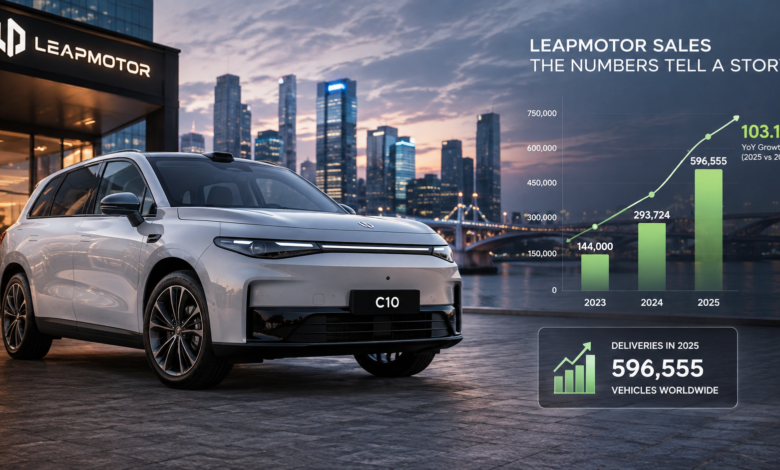
The latest leapmotor sales figures reveal a company moving from ambitious EV startup to a serious player in China’s new-energy vehicle market. In 2025, Leapmotor delivered 596,555 vehicles worldwide, more than double its 2024 total of 293,724. That 103.1% year-over-year increase is more than an impressive statistic; it shows how quickly the company has expanded its products, manufacturing capacity, customer base, and market reach.
However, sales growth alone does not guarantee long-term success. The more important question is what is driving that growth and whether Leapmotor can maintain its momentum as competition becomes tougher.
What the Latest Leapmotor Sales Numbers Show
The clearest way to understand Leapmotor’s progress is to look at the numbers over several years rather than focusing on one strong month. The company delivered about 144,000 vehicles in 2023 before reaching 293,724 in 2024. In 2025, deliveries climbed again to 596,555 units.
That means the company more than quadrupled annual deliveries in roughly two years. Such growth is significant in an automotive industry where production capacity, supply chains, distribution networks, and consumer trust normally take years to build.
The 2025 figure also represented the company’s strongest annual performance to date. December alone contributed 60,423 deliveries. October and November were even stronger, each exceeding 70,000 vehicles, showing that the company’s sales momentum was not limited to a single temporary spike.
These figures suggest that Leapmotor has achieved something particularly difficult for a young automaker: scale. Higher production volumes can improve factory utilization, purchasing efficiency, and the ability to spread development costs across more vehicles.
Why Leapmotor Sales Grew So Quickly
Several factors help explain the rapid increase in leapmotor sales. One of the most important is the company’s focus on relatively affordable electric and electrified vehicles.
China’s EV market is extremely competitive, with manufacturers fighting over price, range, technology, design, and software features. Leapmotor has positioned many of its vehicles in segments where consumers want modern technology without paying premium-brand prices.
Its product range has also expanded. Models such as the C10, C11, C16, B10, B01, and T03 give the company access to different customer groups. The availability of both battery-electric and extended-range versions in some markets provides another advantage because consumers do not all have the same charging access or driving requirements.
This product strategy matters because sales growth becomes easier when an automaker is not dependent on one vehicle. A broader lineup allows the company to respond to changes in consumer demand and enter additional market segments.
The Importance of the Product Mix
Looking at leapmotor sales without considering the product mix would leave out an important part of the story. Vehicle volume tells us how many cars were delivered, but the models behind those deliveries help explain why customers are buying them.
Leapmotor has increasingly emphasized SUVs and crossover-style vehicles, which are popular with consumers in many markets. The C10 and C16, for example, target buyers looking for more space and family-oriented practicality.
The company is also expanding its newer B-series products. The B10 and B01 are important because they can help Leapmotor reach buyers seeking modern design and technology at competitive prices.
Another notable factor is the company’s approach to technology. Leapmotor has invested heavily in in-house development, including electric powertrains, electronic architecture, batteries, and intelligent vehicle systems. Greater control over important components can potentially reduce costs and help the company introduce technology across several models.
That strategy is particularly valuable in a price-sensitive market. If a manufacturer can offer more equipment without significantly increasing the selling price, it has a better chance of attracting value-conscious customers.
Domestic Strength Is Still the Foundation
China remains the foundation of Leapmotor’s business. In 2025, the company delivered the vast majority of its vehicles domestically, while international deliveries were still a much smaller portion of the total.
This is important because China’s EV market provides enormous scale. A manufacturer that can compete successfully in China gains access to a large customer base and an extremely sophisticated supply chain.
At the same time, China’s market is also one of the most difficult automotive markets in the world. Price competition is intense, new models arrive rapidly, and established companies have substantial resources.
Therefore, strong domestic leapmotor sales are encouraging, but they also create a challenge: the company cannot assume that the same growth rate will continue indefinitely in its home market.
The slowdown in China’s broader automotive and new-energy vehicle growth makes this especially relevant. As incentives change and competition increases, maintaining volume while protecting margins becomes harder.
International Expansion Could Change the Story
The next chapter of leapmotor sales is likely to depend heavily on international markets. Leapmotor has partnered with Stellantis to expand its distribution and manufacturing opportunities outside Greater China.
This partnership gives Leapmotor access to an established global automotive network while allowing Stellantis to participate in the fast-growing Chinese EV sector. For Leapmotor, that can reduce some of the barriers normally faced by a relatively young company entering unfamiliar markets.
Europe is particularly important, but the company’s international ambitions extend beyond Europe to markets in the Middle East, Africa, and other regions.
International expansion can provide a valuable second growth engine. If domestic demand becomes slower, overseas markets could help compensate. It can also increase brand recognition and diversify revenue sources.
However, international expansion is not simply a matter of shipping cars abroad. Automakers must deal with tariffs, regulations, crash standards, local taxes, charging infrastructure, dealer networks, after-sales service, and differences in consumer preferences.
What the Numbers Say About Profitability
Sales volume is only one measure of automotive success. A company can sell hundreds of thousands of vehicles and still struggle financially if each vehicle generates insufficient profit.
This is where the recent Leapmotor story becomes more interesting. In 2025, revenue rose to approximately RMB64.7 billion, while the company reported a full-year net profit of about RMB538 million. Its gross margin also improved substantially compared with 2024.
That improvement suggests that growing volume is beginning to translate into better economics. Manufacturing scale, greater purchasing efficiency, higher utilization, and an expanding product portfolio can all contribute to improved margins.
For investors and industry observers, this is arguably more important than the headline delivery figure. Sustainable growth requires a combination of volume, revenue, margin, and cash generation.
If Leapmotor can continue increasing deliveries while improving profitability, its sales growth becomes considerably more meaningful.
The Challenges Behind the Growth
Despite the impressive figures, leapmotor sales face several risks. The biggest is competition.
Chinese automakers are launching new EVs at a rapid pace. Buyers have more choices than ever, which can force manufacturers to reduce prices or increase equipment levels to maintain market share.
Price competition can increase sales while simultaneously reducing profitability. That is why future results need to be judged not only by delivery numbers but also by average selling prices and margins.
Another challenge is international expansion. A vehicle that performs well in China may not automatically succeed in Europe or another overseas market. Brand awareness, customer expectations, safety requirements, financing options, and charging infrastructure can all affect demand.
There is also the question of brand positioning. Leapmotor needs to establish a clear identity in international markets rather than being perceived simply as another low-cost Chinese EV manufacturer.
What Consumers Can Learn From the Sales Trend
For consumers considering a Leapmotor vehicle, the sales trend provides some useful information. Strong deliveries suggest that the company has reached a meaningful level of production scale and customer acceptance.
A growing sales base can also support a larger service ecosystem. As more vehicles enter the market, dealerships, technicians, parts suppliers, and charging-related services have greater incentives to support the brand.
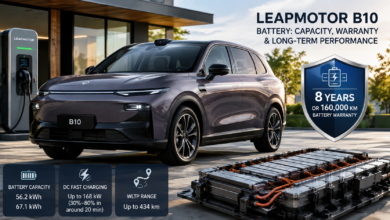
However, buyers should not choose a vehicle purely because its manufacturer has strong sales. Reliability, warranty coverage, resale value, local service availability, software support, battery technology, and charging access remain important.
A popular model can still be unsuitable for a particular buyer. The best purchasing decision depends on the vehicle’s specifications and the support available in the buyer’s market.
What to Watch Next
The next stage of leapmotor sales will be defined by whether the company can convert its domestic success into global growth. Leapmotor has publicly targeted sales of around one million vehicles in 2026, which would require another substantial increase from its 2025 result.
That target is ambitious. Reaching it would require strong demand, continued production expansion, successful launches, and meaningful international growth.
New models will therefore be important. A larger lineup gives Leapmotor more opportunities to attract customers, but it also increases the complexity of manufacturing and marketing.
The company must also maintain competitive pricing without sacrificing profitability. That balance could ultimately determine whether its current growth rate represents a temporary expansion phase or the beginning of a much larger automotive business.
Conclusion
The story behind leapmotor sales is ultimately a story about scale, strategy, and execution. Deliveries increased from about 144,000 vehicles in 2023 to 293,724 in 2024 and then to 596,555 in 2025. The company has also moved toward profitability while expanding its lineup and building international distribution.
Those numbers show genuine progress, but they do not eliminate the challenges ahead. China’s EV market remains highly competitive, while overseas expansion introduces regulatory, operational, and branding risks.
The most important test is therefore not whether Leapmotor can post another impressive sales figure. It is whether the company can grow internationally, protect margins, strengthen its brand, and maintain customer confidence as competition intensifies.
For now, leapmotor sales indicate that the company is no longer merely trying to establish itself. It has achieved substantial scale and is entering a much more demanding stage of its development. The next few years will show whether that rapid growth can become a durable global automotive success.
More EV Car Guides: Read more electric vehicle news, buying guides, reviews, and ownership tips on magazinerock.co.uk.
(FAQs)
How many vehicles did Leapmotor sell in 2025?
Leapmotor delivered 596,555 vehicles worldwide in 2025, representing a 103.1% increase compared with 293,724 deliveries in 2024. The result made 2025 a landmark year for the company and placed it among the leading Chinese emerging new-energy vehicle brands.
Why did Leapmotor sales increase so quickly?
The growth came from several factors, including an expanding model lineup, competitive pricing, strong demand for EVs and extended-range vehicles, increased production capacity, and growing consumer recognition. The company’s focus on controlling important technologies and components has also supported its ability to offer competitive vehicles.
Is Leapmotor expanding outside China?
Yes. International expansion is a major part of Leapmotor’s strategy. Its partnership with Stellantis has helped the company enter additional markets and establish a broader international distribution network. Europe is an important target, while expansion is also taking place across other regions.
Is Leapmotor profitable?
Leapmotor reported its first full-year profit in 2025, with net profit of approximately RMB538 million. Revenue also more than doubled from the previous year. This is significant because profitability indicates that the company’s rapid increase in vehicle deliveries is beginning to translate into stronger financial performance.
What is the outlook for Leapmotor sales?
The outlook is ambitious. Leapmotor has targeted approximately one million vehicle sales for 2026, meaning it would need to grow substantially beyond its 2025 result. Achieving that goal will depend on new model launches, production capacity, domestic demand, international expansion, and the company’s ability to remain competitive without sacrificing profitability.