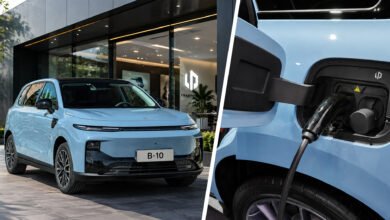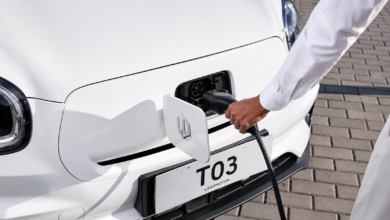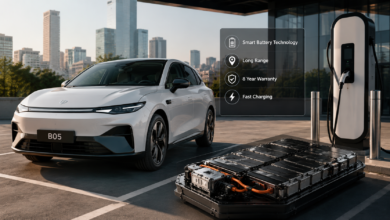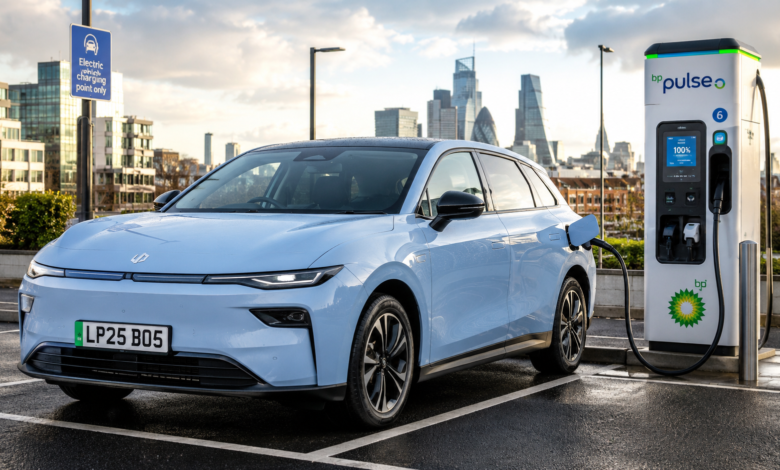
For electric-car buyers, charging speed can be almost as important as range, price and everyday practicality. The leapmotor b05 charging system is particularly relevant for UK drivers because the car combines a 67.1kWh usable battery with an 11kW AC onboard charger and a maximum DC rapid-charging capability of up to 174kW. Under suitable conditions, the manufacturer states that the battery can go from 30% to 80% in around 17 minutes.
That headline figure makes the B05 an interesting option for drivers who regularly travel on motorways or make longer journeys. However, maximum charging power does not mean the car will constantly charge at 174kW. Battery temperature, state of charge, charger capability and other conditions can all affect the actual charging rate.
Understanding how the system works can help prospective owners make better decisions about home charging, public rapid chargers and long-distance journey planning.
What Are the Leapmotor B05 Charging Specifications?
The leapmotor b05 charging hardware is designed to support both convenient everyday AC charging and significantly faster DC charging. The UK model is equipped with a 67.1kWh usable battery, while its onboard AC charger supports charging at up to 11kW when connected to an appropriate supply.
For longer journeys, the more important specification is the DC rapid-charging capability. The B05 can accept up to 174kW under suitable conditions. This means a compatible high-power public charger can replenish a substantial amount of battery energy during a relatively short stop.
The distinction between AC and DC charging is important. AC charging is generally associated with home, workplace and destination charging, while DC rapid charging is mainly useful when a driver needs to add a large amount of energy quickly.
For most owners, the two systems will have different roles. Home charging can take place overnight, while rapid charging becomes more valuable when travelling beyond the car’s normal daily range.
How Fast Can the B05 Charge at a Rapid Charger?
The most impressive aspect of leapmotor b05 charging is its stated 174kW maximum DC charging rate. However, drivers should understand that this figure represents the vehicle’s peak capability rather than a charging speed maintained throughout an entire session.
EV charging normally follows a charging curve. When the battery has plenty of available capacity, the vehicle can accept a higher level of power. As the battery becomes fuller, the charging rate generally decreases. This protects the battery and helps manage temperature.
Leapmotor’s 30% to 80% charging claim is therefore more useful for everyday planning than simply looking at the 174kW figure. A 50-percentage-point increase in around 17 minutes, under favourable conditions, could make a significant difference during a motorway journey.
For example, a driver could stop during a longer trip, connect the B05 to a suitable rapid charger and continue the journey after a relatively short break. The exact amount of additional driving range gained will depend on energy consumption, road speed, weather and driving conditions.
How Long Does AC Charging Take at Home?
For everyday leapmotor b05 charging, home AC charging is likely to be more important than rapid charging for many owners. The B05’s 11kW onboard AC capability allows it to make effective use of a suitable home or workplace charging installation.
Unlike a rapid-charging stop, home charging does not need to be extremely fast. The car can be connected in the evening and left charging for several hours. This makes overnight charging particularly convenient because the vehicle can replenish its battery while the owner is asleep.
Actual charging times depend on the battery’s starting percentage and the electrical supply available to the vehicle. An 11kW charging rate also requires compatible electrical infrastructure. If the charging installation provides less power, the vehicle will charge more slowly.
This highlights an important advantage of electric vehicles: drivers do not always need to wait beside the car while it charges. With home charging, energy can be added during periods when the vehicle would otherwise be parked and unused.
Why the 30% to 80% Charging Window Matters
When discussing leapmotor b05 charging, it is easy to focus on the fastest possible number. In reality, the 30% to 80% charging window is particularly relevant for long-distance driving.
The reason is simple. Rapid charging is generally most efficient when the battery is neither extremely low nor close to full. As the battery approaches a high state of charge, charging power can reduce significantly.
This means that waiting for 100% at a rapid charger may take disproportionately longer than stopping around 80%. For drivers travelling long distances, several shorter charging sessions can sometimes be more time-efficient than trying to completely fill the battery during one stop.
The ideal strategy depends on the journey. Someone travelling a short distance may prefer to charge at home, while a motorway driver may benefit from adding only enough energy to comfortably reach the next destination or charging point.
What Factors Affect B05 Charging Speed?
Several factors can influence real-world leapmotor b05 charging performance. The first is battery temperature. Batteries generally operate most efficiently within a suitable temperature range. A very cold battery may initially accept energy more slowly, while thermal management can help bring the battery toward a more suitable operating condition.
The battery’s state of charge is another major factor. A battery at a relatively low percentage can generally accept more power than one that is already close to full. This is why the advertised peak rate should not be interpreted as a constant figure.
The public charging station also matters. Connecting the B05 to a powerful 350kW charger does not mean the vehicle will charge at 350kW. The car controls how much power it can accept, with 174kW being its stated maximum DC capability.
Weather, charger conditions, electrical limitations and battery-management requirements can also influence the charging session. Consequently, real-world results may differ from official charging figures.
Is the B05 Suitable for Long-Distance UK Driving?
For motorway and longer-distance travel, leapmotor b05 charging is an important part of the car’s overall appeal. The B05 combines its rapid-charging capability with a stated WLTP range of up to around 300 miles, giving drivers a useful combination of range and charging performance.
However, WLTP range should not be treated as a guaranteed motorway range. Higher speeds, cold temperatures, strong winds, rain, heating, air conditioning and heavy loads can all increase energy consumption.
A sensible long-distance strategy is therefore to plan around real-world conditions rather than relying solely on the maximum advertised range. Drivers should identify suitable rapid-charging locations before starting a long journey and keep some additional range available in case a preferred charger is busy or unavailable.
The B05’s rapid-charging capability can then be used strategically. Instead of waiting until the battery is almost empty, drivers can make shorter stops and continue travelling with a comfortable reserve.
How UK Owners Can Get the Best Charging Performance
Getting the best leapmotor b05 charging experience starts with choosing the right charging method for the situation. Home AC charging is usually the most practical solution for regular daily driving because it allows the car to charge while parked overnight.
Public AC charging can also be useful when the vehicle will remain parked for several hours, such as at a workplace, shopping centre or destination location. There is little reason to use a high-cost rapid charger when the car will be stationary for a long period.
DC rapid charging is more appropriate when time matters. During a motorway trip, a high-power charger can add a significant amount of energy during a short break.
Drivers should also avoid assuming that every rapid charger will deliver the same result. Charger availability, power sharing and local network conditions can affect the session. Having an alternative charging location in mind can make longer journeys less stressful.
Does Fast Charging Affect Battery Life?
A common concern surrounding leapmotor b05 charging is whether frequent rapid charging could negatively affect battery longevity. Modern electric vehicles use sophisticated battery-management systems to control charging, temperature and power delivery.
Rapid charging can generate more heat than slower AC charging, which is one reason battery thermal management is important. For everyday ownership, however, drivers do not necessarily need to avoid rapid charging altogether. It is there to provide convenience when required.
A practical approach is to use home AC charging for routine needs and DC rapid charging when travelling or when a faster top-up is genuinely useful.
Battery care also involves avoiding unnecessary extremes. Drivers should follow the manufacturer’s recommendations for charging limits and battery maintenance rather than attempting to optimise every charging session manually.
What Makes B05 Charging Convenient?
The convenience of leapmotor b05 charging comes from having different charging options for different situations. Overnight AC charging can handle normal daily requirements, while rapid DC charging provides flexibility when travelling longer distances.
This means drivers do not have to treat every charging session as a special event. Much of the time, charging can simply become part of the normal parking routine.
Connected vehicle technology can also make EV ownership easier by helping drivers manage charging and prepare the vehicle for journeys. Features such as scheduled charging and battery preparation can be particularly useful when owners want the vehicle ready at a specific time.
The result is a charging system that can support both everyday commuting and occasional long-distance travel without requiring drivers to rely entirely on public rapid chargers.
What Are the Main Challenges?
Despite its strong specifications, leapmotor b05 charging is not completely free from practical challenges. The biggest issue is that advertised maximum charging speeds are achieved only under suitable conditions.
A driver arriving at a rapid charger with a cold battery, high state of charge or limited charger output may see a lower charging rate. This is normal EV behaviour and does not necessarily indicate a problem with the vehicle.
The availability and pricing of public charging infrastructure can also vary across the UK. Popular motorway locations may become busy during holidays or peak travel periods.
For this reason, good journey planning remains important. Drivers should consider charger locations, expected range, alternative charging points and enough reserve energy to deal with unexpected delays.
Leapmotor B05 Charging vs Everyday Driving Needs
The real value of leapmotor b05 charging depends on how the car will be used. A driver covering relatively short daily distances may rarely need public rapid charging. An overnight home charge can provide enough energy for the following day’s driving.
A driver who frequently travels between cities has different requirements. For this type of use, rapid charging becomes much more important because reducing charging time can make long journeys more convenient.
The B05’s combination of range and rapid charging gives it flexibility across both situations. Owners can use slower charging when time is available and switch to rapid DC charging when they need to get back on the road quickly.
This approach is generally more practical than trying to use one charging method for every situation.
Conclusion
Overall, leapmotor b05 charging offers a strong combination of everyday convenience and rapid-charging capability for UK drivers. The car’s 11kW AC onboard charger makes home and workplace charging practical, while its maximum 174kW DC capability provides significantly faster charging during longer journeys.
The manufacturer’s stated 30% to 80% charging time of around 17 minutes is particularly relevant because it demonstrates how quickly the B05 can add a useful amount of energy under favourable conditions. However, actual charging speed will vary according to battery temperature, state of charge, charger capability and other conditions.
For most owners, the best strategy is straightforward: use home AC charging for regular daily needs and reserve rapid DC charging for longer trips or situations where time is limited. With sensible planning, leapmotor b05 charging can fit naturally into everyday UK driving rather than becoming an inconvenience.
More EV Car Guides: Read more electric vehicle news, buying guides, reviews, and ownership tips on magazinerock.co.uk.
(FAQs)
How fast is Leapmotor B05 charging?
The B05 supports up to 174kW DC rapid charging under suitable conditions. The manufacturer states that the battery can charge from 30% to 80% in approximately 17 minutes. Actual charging performance can vary depending on battery temperature, state of charge and charger conditions.
Can I charge the Leapmotor B05 at home?
Yes. The B05 has an 11kW onboard AC charger, making it suitable for compatible home charging installations. Overnight charging is particularly convenient because the car can replenish its battery while parked for several hours.
Will the B05 always charge at 174kW?
No. The 174kW figure represents the vehicle’s maximum DC charging capability. The actual charging rate changes throughout a session and can be affected by battery temperature, state of charge and the public charger being used.
Is rapid charging better than home charging?
Neither option is universally better. Home AC charging is generally more convenient for everyday use because the vehicle can charge overnight. Rapid DC charging is more useful during long journeys when reducing charging time is important.
How can I make charging more efficient on a long journey?
Plan charging stops around your route and avoid relying solely on the maximum advertised charging speed. During longer journeys, stopping around the efficient rapid-charging window can often save time compared with waiting for the battery to reach a very high state of charge. Good journey planning also gives you alternative charging options if a station is busy.