Electric Car Charging Cost UK 2026: Ultimate Guide to EV Charging Prices
Electric Car Charging Cost UK 2026

Introduction
As electric vehicle ownership continues to grow, understanding the Electric Car Charging Cost UK 2026 is becoming increasingly important for drivers across the country. Charging expenses can vary depending on factors such as electricity tariffs, charging location, battery size, and the type of charger used. While many motorists choose to charge at home for greater convenience and lower costs, public charging networks remain essential for long-distance travel and daily flexibility.
Changes in energy prices and advances in charging technology are also expected to influence overall expenses in 2026. By learning how different charging options affect costs, drivers can make informed decisions and better manage their electric vehicle running expenses while maximizing the benefits of EV ownership and efficient charging.
Understanding Electric Car Charging Costs in 2026
The cost of charging an electric car is measured in kilowatt-hours (kWh), which is the same unit used on your household electricity bill. Every EV has a battery with a specific capacity, usually between 40 kWh and 100 kWh. To estimate the cost of a full charge, you multiply the battery size by the electricity price per kWh.
The basic formula is:
Charging Cost=Battery Size (kWh)imesElectricity Price (per kWh)Charging Cost=Battery Size (kWh)imesElectricity Price (per kWh)
For example, if your EV has a 60 kWh battery and electricity costs 25p per kWh, a full charge would cost about £15.
Average Home Charging Costs in the UK 2026
Home charging is where EV ownership becomes financially attractive. Most UK drivers charge overnight using a wallbox charger and an EV-friendly electricity tariff.
| Battery Size | Typical Home Charging Cost (2026) |
| 40 kWh | £6 – £10 |
| 60 kWh | £9 – £15 |
| 75 kWh | £11 – £19 |
| 100 kWh | £15 – £25 |
These figures assume electricity prices between 15p and 25p per kWh, depending on whether you use an off-peak EV tariff or a standard domestic tariff.
Off-Peak EV Tariffs Make a Big Difference
Many UK energy suppliers now offer dedicated EV tariffs with cheaper overnight rates, sometimes as low as 7p to 12p per kWh. Charging a 60 kWh car overnight at 10p per kWh would cost only £6 for a full charge, making EV driving dramatically cheaper than filling a petrol tank.
Public Charging Costs in the UK 2026
Public charging prices vary much more than home charging prices. Costs depend on charger speed, network provider, and location.
Typical public charging rates in 2026:
| Charger Type | Average Price per kWh |
| Slow/fast public charger (7–22 kW) | 35p – 55p |
| Rapid charger (50 kW) | 55p – 75p |
| Ultra-rapid charger (100–350 kW) | 65p – 89p |
Using these prices, a 60 kWh battery could cost £33 to £53 for a full charge on an ultra-rapid charger. In practice, drivers rarely charge from 0% to 100% at public stations, but the figures show why home charging is preferred whenever possible.
Why Rapid Charging Costs More
Rapid and ultra-rapid chargers deliver electricity much faster, often adding hundreds of miles of range in under 30 minutes. The infrastructure, grid connection, and operating costs are much higher, which is reflected in the price per kWh. These chargers are designed for convenience and long-distance travel rather than everyday cheap charging.
Monthly and Annual Charging Costs for UK Drivers
To understand the real-world Electric Car Charging Cost UK 2026, it helps to look at typical annual mileage.
Example: Driver covering 10,000 miles per year
Assume the EV averages 4 miles per kWh, which is common for many modern electric cars.
Annual electricity needed: 2,500 kWh (10,000 ÷ 4)
Home charging at 15p/kWh: £375 per year
Home charging at 25p/kWh: £625 per year
Public charging at 60p/kWh: £1,500 per year
Even at higher home electricity rates, EV charging remains substantially cheaper than petrol for most drivers.
Comparing EV Charging Costs with Petrol in 2026
Suppose a petrol car averages 45 mpg and petrol costs £1.55 per litre in 2026.
10,000 miles would require about 1,010 litres of petrol.
Annual fuel cost: approximately £1,565.
Compared with £375–£625 for mostly home-charged EV driving, the savings can be substantial. However, drivers who rely heavily on expensive public rapid chargers may see smaller savings.
Factors That Affect Electric Car Charging Cost UK 2026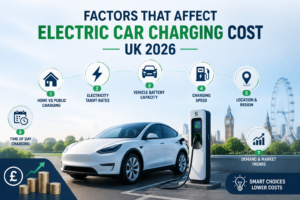
1. Battery Size
Larger batteries cost more to fill, but they also provide more driving range. A luxury EV with a 100 kWh battery will cost much more per charge than a compact EV with a 40 kWh battery.
2. Electricity Tariff
This is one of the biggest factors. Drivers using off-peak EV tariffs can cut charging costs by 40–60% compared with standard tariffs.
3. Charging Location
Home charging is cheapest, workplace charging is often free or discounted, destination chargers at supermarkets or hotels may be low-cost or complimentary, and motorway rapid chargers are the most expensive option.
4. Driving Efficiency
An EV that achieves 5 miles per kWh will cost less per mile than one achieving 3 miles per kWh. Weather, speed, tyre pressure, and driving style all affect efficiency.
5. Charging Losses
Not all electricity drawn from the grid reaches the battery. Around 5–10% is lost during charging, especially with AC home charging. Real-world costs are therefore slightly higher than the simple battery-size calculation suggests.
Cost Per Mile: The Figure Most Drivers Care About
A useful way to compare vehicles is cost per mile.
Typical EV cost per mile in 2026:
| Charging Method | Approximate Cost per Mile |
| Home off-peak charging | 2p – 3p per mile |
| Standard home charging | 4p – 6p per mile |
| Public fast charging | 8p – 14p per mile |
| Motorway ultra-rapid charging | 12p – 18p per mile |
| Typical petrol car | 14p – 18p per mile |
This shows why EV owners who can charge at home usually enjoy the greatest savings.
Is Installing a Home Charger Worth It in 2026?
For most EV owners, yes. A dedicated 7 kW home wallbox typically costs £700–£1,200 installed in 2026, depending on the property and electrical work required. While this is an upfront expense, the lower electricity rates available through home charging can recover the cost over time.
Example savings
If you save £800 per year compared with petrol, a home charger could effectively pay for itself in around 12–18 months.
Best Ways to Reduce Your EV Charging Costs in 2026
Charge overnight on an EV tariff
Use off-peak electricity whenever possible. This is the single biggest way to reduce charging costs.
Install a smart home charger
Smart chargers automatically schedule charging during the cheapest hours and can integrate with your energy tariff.
Avoid unnecessary rapid charging
Use motorway rapid chargers mainly for long trips. Regular daily charging is far cheaper at home.
Improve driving efficiency
Smooth acceleration, moderate motorway speeds, and properly inflated tyres can noticeably improve miles per kWh.
Take advantage of free or discounted charging
Some workplaces, supermarkets, hotels, and retail parks offer free or low-cost charging for customers or employees.
Will EV Charging Costs Rise in the Future?
Electricity prices can fluctuate, but several trends are shaping the future of Electric Car Charging Cost UK 2026:
Increased renewable energy generation may help stabilise long-term electricity prices.
More competition among public charging networks could improve pricing transparency.
Smart charging and vehicle-to-grid technology may allow EV owners to charge when electricity is cheapest and even sell energy back to the grid in the future.
Public charging prices may remain relatively high due to infrastructure and demand charges, especially on rapid networks.
Who Pays the Most for EV Charging in 2026?
Drivers who pay the most are typically those who:
Do not have access to home charging.
Rely mainly on motorway rapid chargers.
Drive large SUVs with 75–100 kWh batteries.
Cover high annual mileage using public charging networks.
For these drivers, EV savings over petrol can shrink considerably. However, for households with a driveway and access to overnight charging, electric cars remain one of the cheapest ways to travel per mile in the UK.
Conclusion
The Electric Car Charging Cost UK 2026 depends heavily on how and where you charge your vehicle. For drivers with access to home charging and an off-peak electricity tariff, running an electric car can be dramatically cheaper than owning a petrol or diesel vehicle. A typical EV driver covering 10,000 miles a year may spend only a few hundred pounds on electricity, compared with well over a thousand pounds on petrol.
However, drivers who depend mainly on public rapid charging will face much higher costs, especially on motorway networks. Even so, EVs still offer advantages in maintenance, taxation, and environmental impact that can offset some of the higher charging expenses.
For most UK households in 2026, the key to affordable EV ownership is simple: charge at home, charge overnight, and use rapid chargers mainly for long journeys.
FAQs About Electric Car Charging Cost UK 2026
1. How much does it cost to fully charge an electric car in the UK in 2026?
A full charge typically costs £6–£25 at home, depending on battery size and electricity tariff. Using public rapid chargers can raise the cost to £30–£50+ for a full charge.
2. Is charging an electric car cheaper than petrol in 2026?
Yes, for most drivers. Charging at home usually costs 2p–6p per mile, while petrol cars commonly cost 14p–18p per mile in fuel.
3. What is the cheapest way to charge an electric car in the UK?
The cheapest method is overnight home charging on an off-peak EV electricity tariff, where electricity can cost as little as 7p–12p per kWh.
4. Are public EV chargers expensive in 2026?
Public chargers, especially rapid and ultra-rapid chargers, are significantly more expensive than home charging. Prices commonly range from 55p to 89p per kWh.
5. How much does a home EV charger installation cost in 2026?
A typical 7 kW home wallbox installation costs around £700–£1,200, depending on the charger model and installation complexity.

2 Comments