
Introduction
As electric vehicles become increasingly popular across the country, understanding Public EV charging prices UK is essential for every EV driver. The cost of charging away from home can vary depending on the public charging network UK, charger speed, location, and the operator’s pricing model. Whether you use a rapid EV charging cost option at motorway services or a slower charger in a town centre, knowing what influences prices can help you save money.
Factors such as EV charging cost per kWh, battery capacity, and charging efficiency all play an important role in your overall electric vehicle charging cost. This guide explains everything you need to know about charging prices in the UK in 2026, helping you make informed and cost-effective charging decisions.
What Are Public EV Charging Prices UK in 2026?
The Public EV charging prices UK market has continued to evolve as charging infrastructure expands across England, Scotland, Wales, and Northern Ireland. More charging operators are competing for customers, but prices still differ depending on network quality, charging technology, and electricity costs.
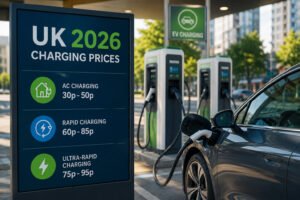
Most public chargers now charge drivers based on pence per kWh, making pricing more transparent than in previous years. However, some operators may also include connection fees, idle fees, or parking charges.
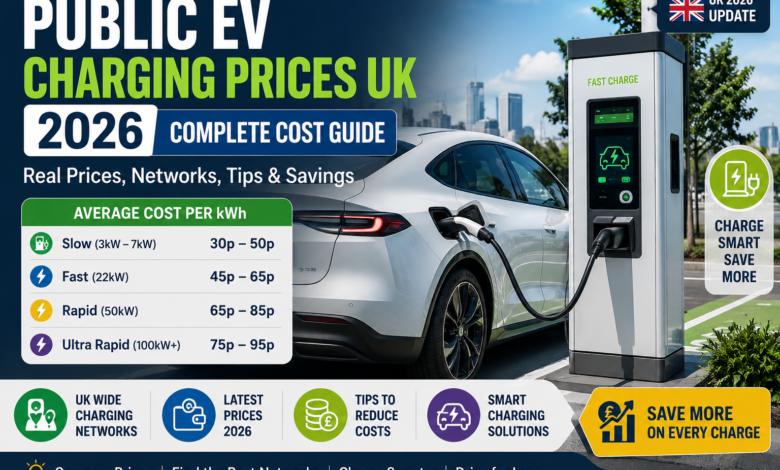
In 2026, the average EV charging cost per kWh generally falls into these ranges:
- Slow chargers (3kW–7kW): around 30–50p per kWh
- Fast chargers (22kW): around 45–65p per kWh
- Rapid chargers (50kW): around 65–85p per kWh
- Ultra rapid chargers (100kW+): around 75–95p per kWh
The exact EV charging prices UK depend on the charging operator, location, time of day, and whether you use a membership plan or pay-as-you-go charging.
As the UK continues investing in EV charging infrastructure, more competition may gradually improve pricing for drivers.
Factors That Affect Public EV Charging Cost UK
Several factors determine the final amount you pay during a charging session.
Charging Speed
One of the biggest influences is charging speed.
Ultra rapid charging prices are usually higher because these chargers deliver much more power in less time. Drivers travelling long distances often choose ultra rapid chargers despite the premium price because they save valuable travel time.
Meanwhile, slower public chargers are usually more economical if your vehicle will remain parked for several hours.
Charging Network
Every public charging network UK sets its own pricing policy.
Popular operators such as Tesla Supercharger, Gridserve, InstaVolt, Ionity, BP Pulse, Shell Recharge, Osprey Charging, Fastned, Pod Point, Believ, Connected Kerb, ubitricity, and Sainsbury’s Smart Charge all have different charging tariffs.
Some offer discounted prices through EV charging membership or subscription plans, while others focus on convenient pay-as-you-go charging.
Location
Charging in city centres or motorway services is often more expensive than charging in supermarkets, retail parks, or workplace locations.
For example, motorway charging generally commands higher prices due to convenience and faster charging equipment.
Time of Charging
Certain charging operators now encourage smart charging by offering lower prices during quieter periods.
Where available, charging during off-peak hours can significantly reduce overall EV charging expenses.
Average EV Charging Cost in Real-World Scenarios
The actual average EV charging cost depends on battery size and energy consumption.
Consider an EV with a 60kWh battery.
Charging from 20% to 80% requires approximately 36kWh.
If the charger costs 70p per kWh, the charging session would cost approximately £25.20.
Charging the same vehicle on an ultra rapid charger charging 90p per kWh would cost approximately £32.40.
For larger electric SUVs with 80kWh batteries, a similar charging session naturally costs more.
Smaller city EVs with batteries around 40kWh usually require much less electricity, making their electric vehicle charging cost considerably lower.
These examples show why understanding EV charging tariffs UK helps drivers estimate costs before arriving at a charging hub.
Home vs Public Charging: Which Offers Better Value?
One of the biggest questions for new EV owners is whether home vs public charging offers better value.
For most drivers, home charging remains the cheapest option because domestic electricity tariffs are generally lower than public charging prices.
Drivers with smart meters may benefit from off peak electricity rates, making overnight charging particularly economical.
Those with rooftop solar panels can also reduce costs through solar charging, lowering their dependence on public chargers.
However, not everyone has access to a home charger.
Apartment residents, urban drivers, and people without private parking often rely on public charging stations, making public infrastructure essential for widespread EV adoption.
Although Public EV charging prices UK are higher than home charging, they still compare favourably with many petrol and diesel fuel costs, especially when considering lower maintenance expenses and improved energy efficiency.
Public Charging Networks and Pricing Differences
The UK now has a mature network of charging providers offering different pricing models.
Tesla Supercharger continues expanding access beyond Tesla vehicles in selected locations.
Gridserve remains popular at motorway charging hubs due to reliable rapid charging.
Ionity specialises in ultra rapid charging for long-distance travel.
BP Pulse, Shell Recharge, InstaVolt, and Osprey Charging have expanded nationwide coverage.
Retail-based charging providers such as Sainsbury’s Smart Charge and Pod Point offer convenient charging while shopping.
Residential solutions from Connected Kerb, Believ, and ubitricity support growing demand for on street EV charging.
Apps like Zapmap help drivers compare charging network prices, locate available chargers, and estimate charging costs before arriving.
Comparing networks before travelling can help identify the best public charging network UK for your route and budget.
Is Rapid EV Charging Worth the Extra Cost?
Many drivers wonder whether paying a higher Rapid EV charging cost is worthwhile.
The answer depends on your journey.
For everyday commuting, slower charging is often more economical.
However, during long-distance travel, rapid charging dramatically reduces waiting times.
A charger delivering over 150kW may add hundreds of miles of electric mileage during a short stop, making the additional cost worthwhile for business travellers and families covering long motorway journeys.
The convenience, improved charging technology, and growing availability of charging hubs continue making rapid charging an attractive option.
How to Reduce Your Public EV Charging Expenses
Although Public EV charging prices UK continue changing, drivers have several practical ways to lower costs.
Choosing cheapest public EV charging providers whenever possible can make a noticeable difference over the year.
Membership plans often reduce public charger prices, particularly for frequent users.
Planning journeys in advance allows drivers to compare public charger comparison tools before travelling.
Using slower chargers whenever time allows usually costs less than relying exclusively on ultra rapid chargers.
Maintaining good battery health also improves charging efficiency, helping maximise every kilowatt hour.
Keeping tyre pressures correct, driving smoothly, and reducing unnecessary weight improve cost per mile EV, lowering total ownership costs.
Future Trends in EV Charging Prices UK
The future of EV charging prices UK will depend on electricity markets, renewable energy investment, government policy, and charging competition.
Growing adoption of renewable electricity, expanding charging infrastructure, and smarter grid management may help stabilise pricing over time.
More operators are investing in intelligent charging technology that balances demand across the smart grid, improving efficiency for both charging operators and EV drivers.
Subscription services, loyalty rewards, and dynamic electricity tariffs are also becoming increasingly common.
As electric vehicle ownership grows, stronger competition should encourage more affordable public charging cost UK options across the country.
Conclusion
The Public EV charging prices UK landscape in 2026 is more transparent, competitive, and accessible than ever before. Although prices vary between charging operators, charger speeds, and locations, understanding EV charging cost per kWh, charging tariffs, and network differences allows drivers to make informed decisions. Home charging usually remains the most affordable solution, but public charging continues to play a vital role for long-distance travel and drivers without private parking. By comparing charging networks, using memberships where beneficial, and planning charging sessions carefully, EV owners can significantly reduce charging expenses while enjoying the long-term financial and environmental benefits of electric mobility.
FAQs
1. How much does public EV charging cost in the UK in 2026?
The average Public EV charging cost UK ranges from approximately 30p to 95p per kWh depending on the charger type, charging operator, location, and charging speed. Slow chargers are generally the cheapest, while ultra rapid chargers cost more because they deliver electricity much faster.
2. Is public EV charging cheaper than petrol?
In many situations, yes. Although public charging costs have increased in recent years, the overall electric car running costs are still often lower than driving a comparable petrol or diesel vehicle. Savings depend on electricity prices, vehicle efficiency, and annual mileage.
3. Which public charging network is the cheapest?
There is no single cheapest provider nationwide because pricing changes frequently. Networks such as Gridserve, BP Pulse, Pod Point, Tesla Supercharger, Shell Recharge, and Believ may offer different prices depending on location, membership discounts, and charging speed. Comparing prices before travelling is the best approach.
4. Why are rapid chargers more expensive?
Rapid charger price and ultra rapid charging prices are higher because these chargers require expensive equipment, stronger grid connections, and ongoing maintenance. Their biggest advantage is dramatically shorter charging times, making them ideal for motorway journeys and long-distance travel.
5. Can I reduce my public EV charging costs?
Yes. You can lower your EV charging expenses by choosing slower chargers when practical, comparing charging network prices, using EV charging subscription discounts, charging during off-peak periods where available, planning routes in advance, and improving driving efficiency to reduce energy consumption.


2 Comments